
 Destinations, Experiences & East Africa Travel
What is a Kenya and Tanzania Safari Combined?
A Kenya and Tanzania safari is a multi-country East Africa itinerary that combines the best of both nations in a single journey. Kenya’s Maasai Mara delivers the Great Migration and iconic big-cat sightings; Tanzania’s Serengeti and Ngorongoro Crater add unmatched wildlife density and dramatic landscapes. Most combined itineraries run 10–14 days, moving between the two countries by charter flight or at the Namanga border crossing. The result is one of the most complete wildlife experiences available anywhere on Earth
Key Takeaways
- A Kenya and Tanzania safari gives you two distinct ecosystems, one seamless journey
- The Maasai Mara (Kenya) and the Serengeti (Tanzania) share the same ecosystem and the same wildebeest herds
- Flying between the two countries saves 2–3 days of travel time and is strongly recommended
- The East African Tourist Visa covers both Kenya and Tanzania on a single document
- Best time to travel: June–October for the Great Migration; January–February for a quieter, equally rewarding experience
- Adding Zanzibar or Diani Beach at the end transforms the safari into a complete East Africa escape
- Entice Africa Safaris is Nairobi-based, KATO Bonded, and manages both Kenya and Tanzania itineraries in-house
Kenya and Tanzania Safari: Why Two Countries Are Better Than One
There is a moment, somewhere between your first lion sighting in the Maasai Mara and the sight of a million wildebeest pouring across the Serengeti plains, when you understand why so many travelers combine Kenya and Tanzania into a single journey.
Planning a safari? Get a free, tailor-made quote in 6 hours →
These are not two separate safaris. They are two movements of the same symphony.
Kenya draws you in with accessibility, world-class guiding, and the raw drama of big-cat country. Tanzania deepens the experience: the Serengeti stretches to a horizon you cannot see the end of, the Ngorongoro Crater holds one of the densest concentrations of wildlife on the planet, and Zanzibar waits at the end like a reward you haven’t quite earned yet.
Combined, a Kenya and Tanzania safari is the most complete wildlife itinerary available in Africa. This guide explains how to plan it well.
What Makes a Kenya and Tanzania Safari Different from Either Alone?
The honest answer is scale of both landscape and experience.
In Kenya alone, you get outstanding wildlife and world-class guiding infrastructure. In Tanzania alone, you get some of the planet’s most pristine wilderness. But the traveler who does both in sequence gets something neither destination offers independently: the complete arc of the Great Migration, across two countries and two ecosystems, with a contrast in landscape and atmosphere that makes each destination sharper by comparison.
The Maasai Mara and the Serengeti are, ecologically, the same system. The wildebeest don’t know or care which side of the border they’re on. Following their route north into Kenya from July, south back into Tanzania in October is one of the few ways to experience a natural event at its full, epic scale.
There is also a tonal difference that experienced travelers appreciate. Kenya moves faster: the Mara, Amboseli, and Laikipia are accessible, well-connected, and beautifully served by comfortable lodges and expert guides who have been doing this for decades. Tanzania moves slower: the Serengeti is vast, remote camps are genuinely off-grid, and the Ngorongoro Crater is so dense with wildlife it can feel prehistoric. One energises you. The other quiets you down.
Both, in the same trip, give you the full register of what a safari in East Africa can be
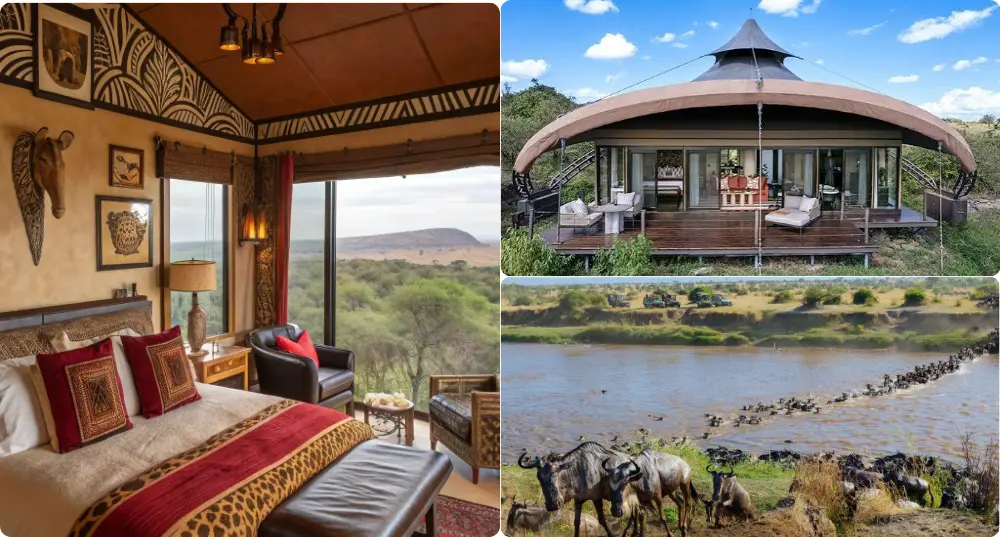
Where to Go: The Essential Regions for a Combined Kenya and Tanzania Safari
Kenya
The Maasai Mara National Reserve
Kenya’s crown jewel and the natural starting point for most combined itineraries. The Mara hosts resident lion prides year-round, and between July and October, the Mara River crossings bring one of nature’s great spectacles to your vehicle window. The private conservancies bordering the reserve — Mara North, Olare Motorogi, Naboisho — offer exclusive game viewing without the crowds, on night drives and walking safaris that the national reserve itself does not permit.
Amboseli National Park
Just four hours south of Nairobi by road, or 45 minutes by charter flight, Amboseli offers the iconic image of Africa: vast elephant herds moving across open plains while Kilimanjaro just across the Tanzanian border glows on the horizon on clear mornings. Amboseli is particularly strong in January and February, when Kilimanjaro is more consistently clear and the elephant herds are at their most spectacular.
Laikipia Plateau
Kenya’s less-visited but deeply rewarding northern conservancy circuit. Laikipia is where you walk alongside black rhino, track wild dogs, and experience the bush at a pace and depth that the busier southern parks cannot offer. Ol Pejeta Conservancy and Solio Rhino Sanctuary at JW Marriott Solio are standout experiences for travellers who value conservation as part of their itinerary.
Tanzania
The Serengeti National Park
The Serengeti is the anchor of any Tanzania safari and one of the greatest wildlife areas on Earth. Over 1.5 million wildebeest, 500,000 zebra, and countless predators move across its 14,763 square kilometres with a freedom and scale that still surprises even experienced safari travellers. The Serengeti’s northern sector, closest to the Kenya border, sees the most dramatic river crossings during peak migration season.
Ngorongoro Crater
The world’s largest intact volcanic caldera is also one of its most extraordinary wildlife sanctuaries. The 600-metre-high walls contain resident populations of all of the Big Five, including one of East Africa’s largest concentrations of black rhino. A full day in the crater is an experience unlike anywhere else on the continent — dense, contained, and quietly astonishing.
Tarangire National Park
Tarangire is one of Tanzania’s most underrated destinations and an excellent addition to any northern Tanzania safari. During the dry season, the Tarangire River becomes a wildlife magnet: the largest elephant herds in Tanzania gather here, alongside tree-climbing lions, giant baobabs, and a bird list that makes ornithologists genuinely emotional. It is also significantly less crowded than the Serengeti.
Zanzibar
The natural conclusion to a Kenya and Tanzania safari and a destination that changes the entire character of the trip. Zanzibar is a 35-minute flight from Dar es Salaam: white coral sand, the Indian Ocean in colours you will struggle to believe are real, and Stone Town’s UNESCO-listed alleyways and spice markets. Most travellers spend 3–5 nights here after the safari circuit. It is, without exaggeration, one of the world’s finest safari-and-beach combinations.

Sample Kenya and Tanzania Safari Itineraries
The itineraries below are starting frameworks. Every journey Entice Africa Safaris designs is built around the specific traveller: your dates, your comfort preferences, your wildlife priorities, and the pace at which you want to move.
No two journeys are identical. We match your comfort level, dates and priorities to the precise lodges, guides and routing that deliver the right experience for your trip. Both Kenya and Tanzania operations are managed in-house from our Nairobi office.