
 Safari, Wildlife & Conservation
Samburu Special Five: The Safari Animals Most Visitors Never Get to See
You’ve heard of the Big Five. You know the lion, the leopard, the elephant, the rhino, the buffalo.
But there is another five. A rarer five. A five so exclusive to one remote corner of Kenya that most safari travelers go their entire lives without ever knowing it exists.
Meet the Samburu Special Five five extraordinary animals found almost nowhere else on Earth, all living in the sun-baked, acacia-dotted wilderness of northern Kenya’s Samburu National Reserve.
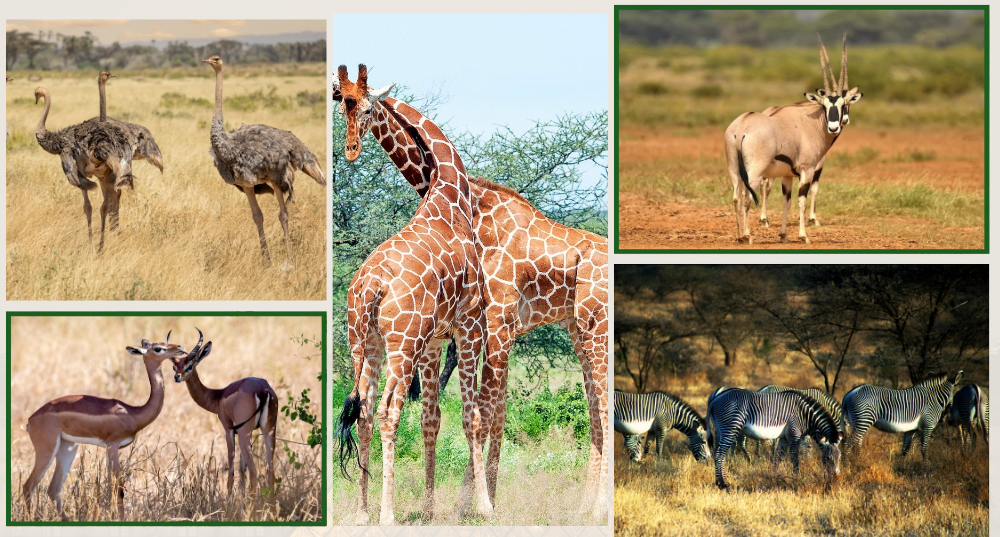
A reticulated giraffe standing 18 feet tall, its coat a mosaic of geometric patterns, browsing unhurried at treetop level. A Grevy’s zebra, the largest wild equine on the planet, its narrow stripes so precise they look hand-drawn. A gerenuk rising impossibly upright on its hind legs to reach a branch no other animal can touch. A Beisa oryx cutting a silhouette so elegant against the evening sky that photographers just stop talking. A Somali ostrich, vivid and electric, sprinting across the open plains at 70 kilometres per hour.
These are not supporting cast. These are the headline acts of one of Africa’s most underrated safari destinations and Entice Africa Safaris will take you straight to them.
|
1. Reticulated Giraffe — The World’s Most Beautiful Giraffe
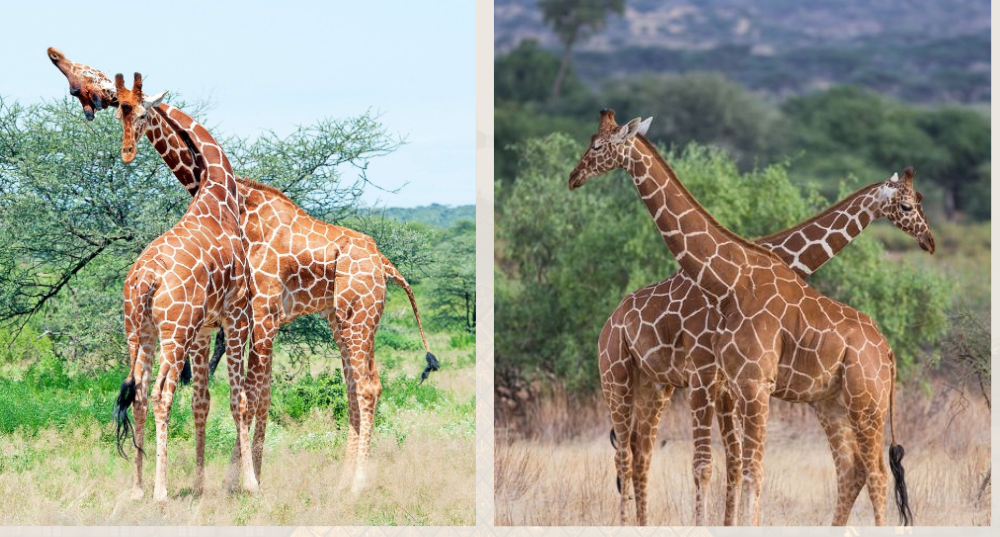
Of all the Samburu Special Five animals, the reticulated giraffe is perhaps the most visually arresting. While the more common Masai giraffe has irregular, jagged markings, the reticulated giraffe is nature working with a ruler. Its markings are bold, polygon-shaped, separated by sharp white lines, like a stained-glass window stretched over the tallest land animal on Earth.
Fewer than 16,000 remain in the wild. Their range is shrinking. Samburu National Reserve is one of the last strongholds.
On a game drive along the Ewaso Nyiro River, you will almost certainly encounter them browsing from acacia canopies, moving in small family groups across the open plains, or standing motionless in the golden light of a northern Kenya evening. Unlike many wildlife sightings that require patience and luck, reticulated giraffes in Samburu are reliably present and remarkably relaxed around vehicles.
- Height: up to 5.8 metres (19 feet) the tallest land animal on Earth
- Population: fewer than 16,000 remaining globally
- Status: Vulnerable (IUCN Red List)
- Best sighting: open plains and riverine areas, morning and late afternoon
- Where you won’t find them: Maasai Mara, Amboseli, Tsavo Samburu is essential
The reticulated giraffe is reason alone to visit northern Kenya.
2. Grevy’s Zebra — The Emperor of the Plains
The Grevy’s zebra doesn’t just look different from the plains zebra you’ve seen in wildlife documentaries. It is a completely different animal larger, more solitary, more ancient, and far rarer.
It is the largest wild equine in the world. Its stripes are narrow, precise, and stop at a clean white belly. Its ears are enormous and rounded. It has a broad black dorsal stripe running from mane to tail. Standing next to a plain’s zebra, it looks like it belongs to an earlier, more refined era of evolution.
Named after French President Jules Grévy, who received one as a diplomatic gift from Abyssinia in 1882, the Grevy’s zebra was once known as the Imperial Zebra. The name suits it. There is something regal about the way it carries itself across the semi-arid scrubland of northern Kenya.
Approximately 3,000 remain in the wild. Kenya holds around 90% of the global population. Samburu National Reserve is one of the most reliable places on Earth to see them.
- Weight: up to 450 kg the largest wild equine on the planet
- Population: approximately 3,000 globally (down from 15,000 in the 1970s)
- Status: Endangered (IUCN Red List)
- Distinctive feature: narrow stripes that stop at the belly; large rounded ears
- Conservation: protected by Grevy’s Zebra Trust, founded 2007
|
3. Gerenuk — The “Giraffe Gazelle” That Stands Like No Other Animal
The gerenuk is the Samburu Special Five’s showstopper moment.
It is an antelope with an extraordinarily elongated neck and legs so unusual in proportion that the first European naturalists who encountered it struggled to classify it. The Samburu people named it gerenuk, meaning “giraffe-necked.” The description is apt. It is essentially a gazelle that evolved to fill the ecological niche of a giraffe, browsing at heights that no other antelope can reach.
But the signature moves the thing that stops you cold on a game drive is when a gerenuk rises onto its hind legs. Fully upright, perfectly balanced, it grazes from branches two metres off the ground, front legs tucked against its chest, eyes scanning the horizon. It is one of the most theatrical wildlife sightings in all of Africa. And you will almost certainly see it in Samburu.
Gerenuks rarely drink water, extracting moisture from the leaves and shoots they browse. They are built for arid country Samburu’s scrubland is perfect habitat, and the reserve hosts a healthy resident population.
- Height at shoulder: approximately 80–95 cm; neck extends feeding range to 2+ metres
- Status: Near Threatened (IUCN Red List); numbers declining
- Habitat: thorny scrubland and acacia bush does not need open water
- Signature behavior: bipedal feeding stance, unique among antelope
- Also known as: giraffe gazelle, Waller’s gazelle

4. Beisa Oryx — The Warrior of the Northern Frontier
If there is a more cinematically perfect animal in Samburu than the Beisa oryx, we haven’t found it.
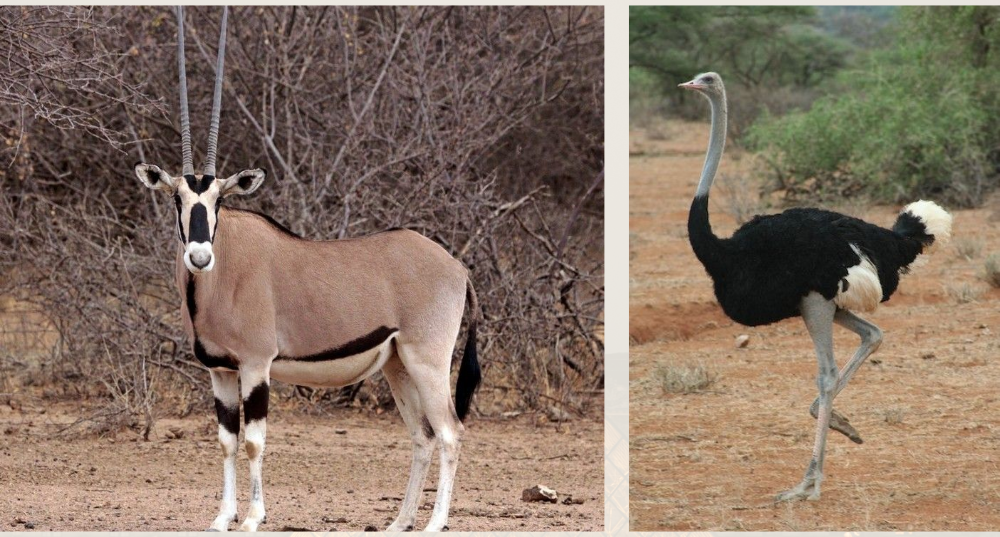
Its horns are long, straight, and parallel reaching up to 80 centimetres in mature individuals, giving it the appearance of a prehistoric guardian standing watch over the plains. Its face is painted in bold black-and-white markings, precise and dramatic. Its flanks are pale fawn, marked with dark stripes along the lower body. In the dry morning light of northern Kenya, against a backdrop of volcanic rock and yellow grass, the Beisa oryx is extraordinary.
It is also built for survival in conditions that would break most animals. Beisa oryx can raise their body temperature during the heat of the day to reduce water loss through sweating a physiological adaptation so sophisticated that it has been studied by engineers designing cooling systems. They can go days without drinking, extracting moisture from dry vegetation. They thrive in conditions where most safari animals struggle to survive.
In Samburu, they are seen in small herds of five to twenty, moving through the open plains and scrubland with a slow, deliberate grace. Sightings are consistent throughout the year.
- Horn length: up to 80 cm in mature animals; both sexes carry horns
- Status: Least Concern but declining due to habitat encroachment
- Adaptation: thermoregulates body temperature to reduce water loss
- Group size: typically 5–20 individuals led by a dominant male
- Habitat: open semi-arid plains and sparsely vegetated scrubland
5. Somali Ostrich — The Blue-Necked Giant of the African Plains
The Somali ostrich is the newest member of the Special Five in scientific terms reclassified as a separate species from the common ostrich in 2014 and it is a genuinely striking animal.
Where the common ostrich has a pink-grey neck, the Somali ostrich carries a vivid blue-grey coloring that intensifies during breeding season into a deep, electric blue. The male’s plumage is black and white; the female is grey-brown. Both are formidable: the tallest bird on Earth, reaching 2.7 meters, capable of running at 70 kilometers per hour and delivering a kick that can be fatal to predators.
On the open scrubland of Samburu, Somali ostriches are seen striding across the plains with the unhurried confidence of animals that have no serious natural enemies. Their distinctive coloring makes them unmistakable even at distance. And a male in breeding plumage neck glowing blue in the morning light, white tail feathers fanned is one of the most visually dramatic sightings the reserve offers.
- Height: up to 2.7 meters the world’s tallest bird
- Speed: up to 70 km/h the fastest running bird on Earth
- Status: Vulnerable; reclassified as distinct species in 2014
- Distinctive feature: vivid blue-grey neck (brighter in breeding season)
- Found: northern Kenya, southern Ethiopia, Somalia not found in Maasai Mara or Amboseli
Beyond the Samburu Special Five: What Else Awaits in Northern Kenya
The Samburu Special Five are the headliners. But Samburu National Reserve is far more than five animals. It is one of Kenya’s most complete and extraordinary safari ecosystems.
- Big cats: lions, leopards, and cheetahs are all resident and frequently sighted
- Elephants: studied for decades by Save the Elephants, Samburu’s elephant population is large, relaxed, and remarkable to observe
- African wild dogs: one of Africa’s most endangered predators; occasionally sighted in the broader Samburu ecosystem
- 450+ bird species: including vulturine guineafowl, martial eagle, Taita falcon, and violet-breasted roller
- Crocodiles and hippos: along the Ewaso Nyiro River, which is the life source of the entire ecosystem
- Samburu people: semi-nomadic pastoralists with a culture and traditional dress distinct from the Maasai a profound cultural dimension to the safari experience
|
When Is the Best Time to Visit Samburu National Reserve?
Samburu rewards visitors throughout the year, but two windows stand out:
June to October — Peak Safari Season
The dry season reduces vegetation, concentrating wildlife around the Ewaso Nyiro River. Game viewing is at its finest all five of the Samburu Special Five are reliably seen, lions and leopards are frequently spotted, and the light for photography is exceptional. This is when to come if the Special Five is your primary goal.
January to February — Quiet Season with Outstanding Wildlife
Lower visitor numbers, comfortable temperatures, and strong resident wildlife make January and February one of the most refined times to experience Samburu. Exclusive-use vehicles are easy to arrange, and the reserve’s naturally low crowd levels drop further. Discerning travelers who want a more intimate, private experience often choose this window.
What About the Rainy Season?
March to May brings the long rains. Some tracks become difficult and wildlife is more dispersed. However, the landscape is dramatically green and beautiful, bird species are abundant, and lodge rates reflect the season. For experienced safari travelers and photographers, this is a compelling window.
How to Get to Samburu National Reserve from Nairobi
Samburu National Reserve lies approximately 350 kilometres north of Nairobi about six to eight hours by road or one hour by scheduled light aircraft.
- By air: scheduled flights depart Nairobi’s Wilson Airport daily to Samburu airstrip, operated by Safarilink and AirKenya. Journey time: approximately 50–65 minutes. This is by far the most efficient way to travel and the one we recommend for any itinerary of seven days or fewer.
- By road: the route from Nairobi via Nanyuki or Isiolo is scenic and passable by 4WD. Allows stops at Mount Kenya foothills, Nanyuki town, and the equator. Best for travelers on extended multi-destination itineraries.
- Combined itinerary: Samburu pairs exceptionally well with Laikipia / Solio Rhino Sanctuary and the Maasai Mara. Entice Africa Safaris designs seamless flying itineraries connecting all three destinations.
Frequently Asked Questions: Samburu Special Five
What are the Samburu Special Five?
The Samburu Special Five are five rare wildlife species almost exclusively found in the semi-arid ecosystems of northern Kenya: reticulated giraffe, Grevy’s zebra, gerenuk, Beisa oryx, and Somali ostrich. They are the defining wildlife attraction of Samburu National Reserve.
Where can I see the Samburu Special Five?
The most reliable destination is Samburu National Reserve in northern Kenya, along with the adjacent Buffalo Springs National Reserve and Shaba National Reserve. These animals are not found in the Maasai Mara, Amboseli, or Tsavo. Samburu is where you must go.
How do I get to Samburu from Nairobi?
The most efficient route is a one-hour scheduled light aircraft flight from Nairobi’s Wilson Airport. Road transfer takes six to eight hours and is best suited for extended multi-destination itineraries. Entice Africa Safaris arranges all domestic flights and ground transfers.
Is Samburu good for first-time safari travelers?
Yes. Samburu has reliable infrastructure, outstanding professional guiding, excellent accommodation, and some of Africa’s most consistent and accessible wildlife sightings. The naturally low visitor numbers mean game drives are intimate and unhurried. It is an exceptional choice for both first-time and experienced safari travelers.
Can I combine Samburu with the Maasai Mara
Absolutely and we recommend it. A Samburu + Maasai Mara combination safari delivers two completely different ecosystems, two distinct wildlife experiences, and a journey through the full breadth of what Kenya offers. Entice Africa Safaris designs these combined itineraries seamlessly as all-inclusive bespoke experiences. It is one of our most sought-after safari routes.
How many days do I need in Samburu?
A minimum of three nights allows you to comfortably see all five of the Samburu Special Five alongside lion, elephant, and the reserve’s remarkable birdlife. Four to five nights allows a more relaxed pace and deeper exploration of the ecosystem. We recommend four nights as the ideal Samburu experience.
Why Plan Your Samburu Special Five Safari with Entice Africa Safaris
Entice Africa Safaris is a 100% locally owned, KATO Bonded safari operator based in Nairobi, operating since 2017. We design bespoke, all-inclusive safari experiences across Kenya for discerning travelers from the US, UK, Europe, and beyond.
We know Samburu from the inside. We have long-standing relationships with the reserve’s finest camps and lodges properties where the guiding is extraordinary, the cuisine is refined, and the exclusive wilderness access is guaranteed. We do not sell packages. We design journeys built around what moves you.
- Tailor-made Samburu safari itineraries we build around your dates, interests, and the Samburu Special Five species you most want to see
- Expert naturalist guides with deep knowledge of northern Kenya’s ecosystem
- All-inclusive bespoke experiences: accommodation, meals, game drives, park fees, transfers and domestic flights handled in a single booking
- KATO Bonded your booking is financially protected and backed by Kenya’s leading tourism industry body
- Samburu + Maasai Mara combination itineraries: the two finest safari ecosystems in Kenya, designed as one seamless journey
- 3% of every safari channeled directly into local conservation programs
|
Comments are closed