

 Safari, Wildlife & Conservation
Short answer: Choose calving season (late January to March, Ndutu, Tanzania, births peak in February) for newborn calves and predators. Choose the Mara crossings (July to October, Kenya) to watch herds cross the Mara River. This page helps you pick between them; for the detail, read the calving season safari guide or the Maasai Mara migration guide.
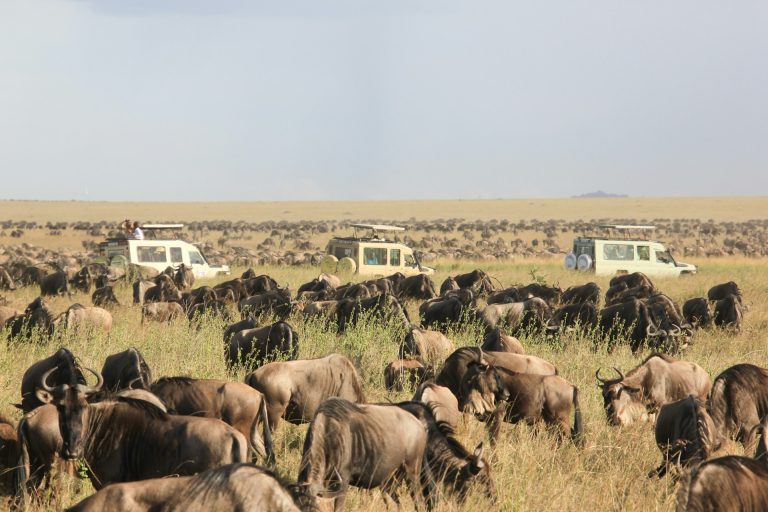
The migration calving season runs from January to March, when wildebeest give birth on the short-grass plains of the southern Serengeti around Ndutu, in Tanzania. The Mara River crossings happen in Kenya’s Masai Mara, where the herds are usually found from about July to October and the busiest crossing action runs from late July to September. Choose calving for newborn calves, predators and green plains, and the Mara for the river drama.
Our Masai Mara safari guide covers the Kenyan side in depth; this article helps you choose between the two seasons by comparing predators, crowds, weather, cost and access. It is the same herd in both places, seen at two points in its yearly circuit, so the choice is about timing, country and the kind of spectacle you want.
Planning this trip? Get a free quote in 6 hours →
At a glance: calving season vs Mara crossings
| Question | Calving season | Mara crossing season |
|---|---|---|
| When | Late January to March, with most births in February | Herds usually in the Mara from about July to October; busiest crossings late July to September |
| Where | Ndutu and the southern Serengeti, Tanzania | Masai Mara, Kenya |
| Main sight | Thousands of newborn calves on open plains | Herds massing at the Mara River and crossing past waiting crocodiles |
| Predators | Lions, cheetahs, hyenas and leopards working the herd | Crocodiles in the river, with big cats and hyenas near the herds |
| Landscape and weather | Green plains, wet-season conditions, showers possible | Drier months, cold mornings, showers still possible |
| Crowds | Generally quieter | Generally busier at the popular crossing points |
| Timing | Births peak in February | Arrival and crossing dates shift with the rains |
| Best for | Photographers, couples and travelers who want predator action | First-time visitors set on seeing a river crossing |
Calving season Serengeti: January to March on the Ndutu plains
Calving happens on the short-grass plains of the south-east Serengeti, around Ndutu, where the Ngorongoro Conservation Area meets Serengeti National Park. Operators describe the season as running from late January into March, with most births in February. Our 10 Day Tanzania’s Calving Season Safari is built around this window.
How many calves are born? The sources disagree. One reference gives roughly 500,000 calves over two to three weeks in February, while an operator says about 8,000 a day at the peak. The two do not fit together neatly, so read both as rough. Both agree that February is the heart of the season.
Predators and photography
Thousands of newborns draw lions, cheetahs, hyenas and leopards onto the plains. Because the grass is short and the views are long, hunts are easy to follow from a vehicle, and sunrise and sunset drives suit photographers well.
Weather and landscape
The herd gathers on these plains in the wet season, so expect green grass and the chance of showers. Bring a light waterproof and a camera that copes with changing light.
We cover the season in more depth in our guides to the wildebeest calving season safari for 2027 and wildebeest calving season in Tanzania, so we do not repeat them here.
Migration season in the Masai Mara: July to October
The herds usually move north into the Mara around July and head back south from about October. Kenyan officials quoted in 2021 put arrivals at mid-July to October, with herds sometimes turning up from mid-June after good rains.
The big draw is the Mara River. Zebras usually lead and wildebeest follow, while crocodiles wait in the water. One operator guide gives late July to September as the best window for crossing sightings. The crossing points on the Kenyan side have names, but names and numbering vary by operator and map, and which one the herds choose on a given day is not something anyone can schedule.
Our complete guide to the Great Migration in the Masai Mara explains the crossings in detail, and our 5 days Masai Mara Migration Safari is a short way to experience them.
Timing is less predictable than the dates suggest
Rain and grass drive the herds. In 2021 Kenyan scientists said the migration was delayed significantly by drier-than-usual weather, and the tourism minister said the herds were stuck in Tanzania. Rainfall and flooding can also change when a crossing happens. Allow several nights in the Mara rather than one or two, so the herds have time to show up.
Weather and landscape
The Mara has two rainy seasons: long rains roughly March to May, peaking in April, and short rains roughly November to December. June to October are the drier months, though showers can still fall. The reserve sits at roughly 1,500 to 2,100 m, so dawn drives are cold. Narok town, outside the reserve at about 1,800 m and drier than the western Mara, has July nights near 10°C and afternoons of 22 to 25°C from June to October.
Where the herd is, month by month
The table follows the herd’s usual route. Exact dates move with the rains, so treat it as a guide; our Great Migration calendar goes month by month in more detail.
| Months | Where the herd usually is | Safari angle |
|---|---|---|
| January to March | Short-grass plains of the south-east Serengeti, around Ndutu | Calving season |
| May to June | Moving north-west toward the Grumeti River area, staying there until late June | Between the two main seasons |
| July | Grumeti and Mara River crossings begin; herds usually move into the Mara | Early crossings |
| Late July to September | In Kenya for the dry season | Peak crossing season |
| October | Usually heading back south | Late crossings |
| November to December | Moving south with the short rains, usually reaching the south by December | Heading back to the calving grounds |
How big is the herd?
Nobody agrees on the number. The official aerial count, flown in March 2023 by Tanzania’s wildlife research institute TAWIRI, found about 1.37 million wildebeest. A 2025 satellite study counted roughly 500,000 to 530,000 in August 2023 imagery, and its authors say that may be slightly high. A safe summary is that estimates range from about 0.5 million to 1.4 million. Part of the gap is timing: the aerial count is flown in March, when the whole herd is on the southern plains, which is one reason calving season is when the herd is gathered in one place.
Crowds, cost and access
Crowds
Crossing season is generally the busier of the two, because many visitors time Kenya trips around the crossings. Calving season spreads over wide plains and generally feels quieter. This is a general pattern, not a visitor count, and it varies by camp and date.
Cost
Neither season has one fixed price. Camp rates change by camp, date and room type, and park and conservancy fees differ between Kenya and Tanzania. The fair comparison is two itemised quotes for the same number of nights, group size and lodge level. Our starting prices below cover different trip lengths, so they do not show which season costs more. An optional Masai Mara hot-air balloon flight is USD 550 per person on top. Fees last verified: October 2026.
Getting there
A calving trip is a Tanzania itinerary; a crossing trip is a Kenya one. Each country has its own entry requirements, and we confirm what applies to your passport when we quote. Ndutu sits where the Ngorongoro Conservation Area meets the Serengeti, so a visit to Ngorongoro Crater can be added to a calving trip.
Two ways to see the herd
- 10 Day Tanzania’s Calving Season Safari: for travelers who want newborn calves and predator action in the southern Serengeti. From USD 6,660 per person.
- 5 days Masai Mara Migration Safari: for travelers who want a short Kenya trip built around the Mara migration. From USD 2,750 per person.
Starting prices are per person for two sharing, based on a midrange lodge in low season. Prices depend on season, group size and lodge choice.
Safaris that fit this guide
 10-Day Tanzania Calving Season SafariNdutu calving, Serengeti and Ngorongoro10 days · from $6,660 ppView trip →
 21-Day Kenya and Tanzania with ZanzibarThe Mara, Serengeti, Ngorongoro and Zanzibar21 days · from $9,050 ppView trip →5-Day Masai Mara Migration SafariMore time with the herds in the Mara5 days · from $2,750 ppView trip →
Every trip is private and can be changed to suit you. Get a free, tailor-made quote in 6 hours →
Trips for Each Season
- 10 Day Tanzania Calving Season Safari: from USD 6,660 per person.
- 7 Days Maasai Mara Migration Safari: from USD 4,900 per person.
- 11 Day Migration Fly-in Package: from USD 7,625 per person.
Prices are per person for two sharing.
Which season suits you?
Choose calving season if you
- want newborn calves and predator hunts in open country
- prefer a greener, generally quieter setting
- are happy with a Tanzania itinerary and can travel between January and March
Choose the Mara crossings if you
- want to watch herds gather at the Mara River
- prefer the drier months of June to October
- want a Kenya itinerary, with the option of a hot-air balloon flight
Whichever you choose, remember that nobody can promise a crossing on a given day, and that the herd moves with the rains rather than the calendar.
Can you see both?
More: Great Migration safari guide, Great Migration calendar, Mara River crossing and wildebeest calving season in Tanzania.
Not on a short trip. The seasons sit months apart, and a single itinerary catches the herd at one point in its circuit. What you can do is combine the two countries: our 21-Day Kenya and Tanzania Safari with Zanzibar links them, from USD 9,050 per person (prices depend on season, group size and lodge choice). Tell us your dates and we will say where the herd is likely to be. If you are still weighing the two countries, our Masai Mara vs Serengeti comparison explains how they fit together.
Get your free safari quote in 6 hours
Tell us your dates and who is travelling. A planner in our Nairobi office replies within 6 hours with a day-by-day itinerary, the camps we suggest and a fully itemised price. No payment is needed to enquire.
Prefer to talk? WhatsApp or call +254 799 871 255.
Frequently asked questions
What is the best time for Great Migration viewing?
It depends on the scene you want. For calving, go between January and March to the southern Serengeti, with most births in February. For river crossings, the herds are usually in the Mara from about July to October, with the busiest action from late July to September. Dates shift with the rains.
Is calving season in the Serengeti or the Masai Mara?
In the Serengeti. It takes place on the short-grass plains of the south-east, around Ndutu in Tanzania, not in the Masai Mara in Kenya.
Can I see river crossings during calving season?
No. From January to March the herd is on the southern plains. The Grumeti and Mara River crossings begin around July, once the herds have moved north.
Which season is quieter?
Calving season is generally the quieter of the two, since the herd spreads across wide plains. The Mara in crossing season is generally busier. Both patterns vary by camp and date, so ask us about the dates you have in mind.
How many wildebeest are in the migration?
Estimates range from about 0.5 million to 1.4 million. The traditional aerial count, flown in March 2023, found about 1.37 million, while a 2025 satellite study counted far fewer in August imagery. The methods and months differ, so neither figure settles the question.
Is the migration on the same dates every year?
No. Timing follows rain and grass. In 2021 the herds reached the Mara late after drier-than-usual weather, while in wetter years they can arrive from mid-June. Treat every date in this article as a usual pattern, not a schedule.
What should I pack for each season?
Warm layers for cold dawn drives, especially in the Mara highlands, and a light waterproof for the green season. Add a hat, sunglasses, binoculars and a camera with a zoom lens; these suit both seasons.


Comments are closed