

 Safari, Wildlife & Conservation
Quick answer: The Great Migration is in the Masai Mara in Kenya from about July to October, with river crossings busiest from late July to September. This guide is for the Kenya side and a July to October 2027 trip. Allow several full days in the reserve, because no one can promise a crossing on a given day.
The Great Migration reaches the Masai Mara in Kenya from about July to October, with the busiest river-crossing action from late July to September. The herd is one population of wildebeest, with zebra and gazelle alongside, that circulates between the southern Serengeti in Tanzania and the Mara, so the Mara sees it for only part of the year. The reserve is about 270 km (170 miles) from Nairobi, a 5 to 6-hour drive or a 45 to 60-minute flight.
This guide covers what the migration is, how many animals take part, when the herds arrive, how the river crossings work, where to stay, what park fees and safaris cost, and how to behave at a crossing. It is the migration chapter of our Masai Mara safari guide, and it plans for a July to October 2027 trip.
Planning this trip? Get a free quote in 6 hours →
The Great Migration at a glance
| Question | Short answer |
|---|---|
| Where is it? | One herd that circulates between the southern Serengeti in Tanzania and the Masai Mara in Kenya. |
| When is it in the Mara? | Usually from about July to October. In years of ample rain in Kenya, the first herds can arrive in mid-June. |
| When are river crossings busiest? | Late July to September. |
| How many animals? | Estimates of the wildebeest range from about 0.5 million to 1.4 million, depending on the method and the month of the count. |
| Getting there | About 270 km (170 miles) from Nairobi: a 5 to 6-hour drive or a 45 to 60-minute flight. |
| Reserve fee, non-resident adult | USD 200 per day from 1 July to 31 December and USD 100 per day from 1 January to 30 June, on a 12-hour ticket. |
| Entice migration trips | Four trips of 5 to 11 days, starting with the 5 days Masai Mara Migration Safari from USD 2,750 per person. Prices depend on season, group size and lodge choice. |
Which guide do you need? This page plans a Mara trip: arrival dates, crossings, camps and costs. For the full circuit across Kenya and Tanzania, read the Great Migration safari guide. For where the herds are each month, use the Great Migration calendar.
What the Great Migration is
The Serengeti-Mara wildebeest herd follows rain and fresh grass in a loop between the southern Serengeti and the Masai Mara. Tanzania’s wildlife research institute, TAWIRI, describes it as the largest migratory population of hoofed animals in the world, and its counts cover a Greater Serengeti Ecosystem that includes the Masai Mara National Reserve and the surrounding conservancies. The Mara is one stage of a loop that runs all year.
In outline, the herd calves on the short-grass plains of the south-east Serengeti between January and March, moves north-west through May and June, begins crossing the Grumeti and Mara rivers in July, spends the dry months in the northern Serengeti and the Mara, and turns south again from about November with the short rains. Ndutu and the calving plains are in Tanzania, not the Mara.
Wildebeest make up most of the herd. Zebra, Thomson’s gazelle, topi and eland travel with them, and zebras usually lead while the wildebeest follow. Crocodiles wait in the Mara River, which is why the crossings draw visitors, and the Mara’s resident lions, leopards, cheetahs and hyenas hunt around the moving herds.
The journey from Tanzania to the Mara is roughly 800 km (500 miles). One commonly cited estimate puts the number of wildebeest that die along the way at about 250,000, from thirst, hunger, exhaustion and predation. That figure covers the whole journey, not the river crossings alone, and it is an estimate rather than a count.
How many animals take part?
There is no single agreed number, and the honest answer is a range. The figure most often repeated is 1.3 million wildebeest, which comes from the traditional aerial counts. A 2025 satellite study challenges it.
| Count | When | Wildebeest | Worth knowing |
|---|---|---|---|
| TAWIRI aerial survey | 28 to 31 March 2023 | 1,366,109, plus or minus 231,741 (standard error) | Photographed along 55 transects; the whole herd is on the southern plains in March. |
| Satellite and AI study in PNAS Nexus | August 2022 imagery | 324,202 to 337,926 | In August the herds are in the northern Serengeti and the Mara. |
| Same study | August 2023 imagery | 502,917 to 533,137 | The authors’ headline is “fewer than 600,000”. |
The researchers behind the satellite study, from Oxford, Princeton and other institutions, say their numbers imply a shortfall of at least 700,000 wildebeest against the 1.3 million estimate, which they note has remained largely unchanged since the 1970s. They also say their counts may be a slight overestimate, because the models cannot reliably tell wildebeest from zebra and eland. TAWIRI, for its part, says its own method needs further improvement in accuracy. The two counts were taken at different times of year, one on the southern plains in March and one in the north in August, which may explain part of the gap.
The long-run record, as TAWIRI tells it, is one of recovery: about 190,000 wildebeest in 1955, a rise after livestock were vaccinated against rinderpest in 1958, more than a million from the late 1970s, a dip in the 1993 to 1994 drought, numbers fluctuating around the million mark from the 1990s to 2012, and the 2015 and 2023 counts as the highest yet seen. For a traveller the point is practical. Whichever count is right, you will be looking at a very large herd, and what decides your trip is where the herd is and what the river does, not the total.
When the herds reach the Masai Mara
The usual window
Wildebeest usually move north into the Mara around July, depending on the weather, and head back south around October, so the migration typically reaches the Mara between July and October. Kenya’s tourism minister described it as mid-July to October in a 2021 statement and added that arrivals can begin in mid-June if Kenya has ample rain. Operators give late July to September as the best window for watching herds cross the Mara River.
The safest summary is this: herds in the Mara from about July to October, with the busiest river-crossing action from late July to September. For a 2027 safari the same window applies. Nobody can name the 2027 crossing dates in advance, so choose your dates by the herd’s usual pattern and leave room for the weather.
Month by month
| Period | Where the herds usually are |
|---|---|
| January to March | Calving on the short-grass plains of the south-east Serengeti, in Tanzania. Most births fall in February. |
| May to June | Moving north-west toward the Grumeti River area in Tanzania, staying until late June. In years of ample Kenyan rain, the first arrivals in the Mara can come in mid-June. |
| July | Crossings of the Grumeti and Mara rivers begin, and herds start crossing onto the Kenyan side. |
| Late July to September | The herds are in Kenya for the dry season. This is the busiest window for river crossings. |
| October to early November | The herds begin heading back south, with the timing set by the short rains. Some are usually still in the Mara in October. |
| December | The herds are usually back in the south. |
For the full calendar, read Great Migration month by month, or our earlier month-by-month guide covering Kenya and Tanzania.
When the timing slips
The pattern is only somewhat predictable. Rain and grass set the pace, and floods can delay or block a crossing. In 2021 Kenyan scientists said the migration was delayed significantly after weak March to May rains and a dry, cold spell from June to August, and the tourism minister said the herds were stuck in Tanzania. If you are travelling at the edges of the window, read what changes in the Mara when the migration is late or thin. The simplest protection is more days at the river.
Mara River crossings: what to expect
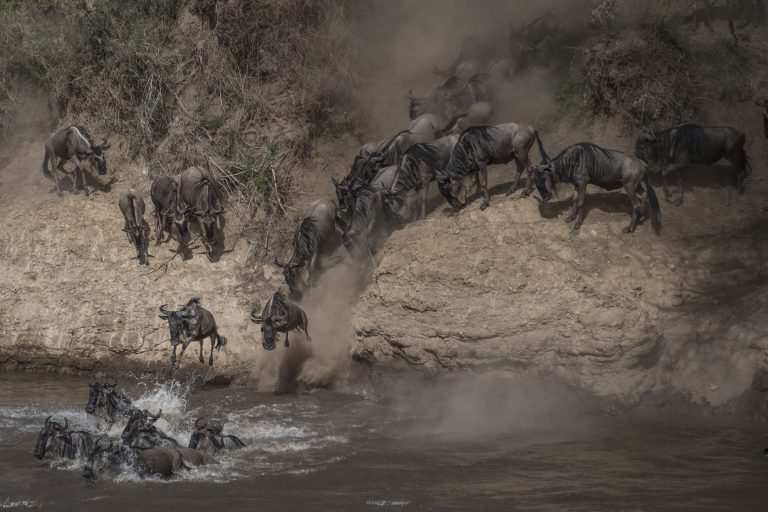
The river is the Mara’s best-known stage. Herds gather on the bank, zebras usually go first, and the wildebeest follow into water where crocodiles wait. A crossing can run for hours, and at one central point an operator guide says it has sometimes lasted three days.
No crossing can be scheduled. A herd may cross within minutes of reaching the bank or leave without crossing, and flooding can block some points. Your guide reads the herd and chooses where to wait. Our guide to Mara River crossings: when, where and how to see one goes into the detail. For orientation, one operator guide numbers the Kenyan crossings 1 to 8. Names and numbering vary between operators and maps, so treat the list as a rough map.
| Crossing point | What the operator guide says |
|---|---|
| Sand River (crossing 1) | In the south-east and less dramatic, because the river is usually dry and shallow. |
| BBC Crossing (crossing 3) | Best viewed from the western bank, the Mara Triangle side. |
| Entim (crossing 4) | Central and isolated. Crossings can run for hours, sometimes three days. |
| Mawe Mawe (crossing 6) | Heavily used, with many crocodiles. |
| Cul de Sac or Kaburu (crossing 7) | Crossings occur almost the whole crossing season. |
| Pontoon (crossing 8) | Next to Mawe Mawe. Only a handful of vehicles can reach it. |
Migration safaris with Entice Africa Safaris
We run four migration trips, from 5 to 11 days. The prices below are from-prices per person, set on midrange lodging in low season for two people sharing. Prices depend on season, group size and lodge choice, so expect a July to September departure to cost more than the from-price shows.
| Trip | Length | From, per person |
|---|---|---|
| 5 days Masai Mara Migration Safari | 5 days | USD 2,750 |
| 7 Days Maasai Mara Migration Safari | 7 days | USD 4,900 |
| 8 Days Migration Majesty Safari | 8 days | USD 6,530 |
| 11 Day Migration Fly-in Package | 11 days | USD 7,625 |
The shortest trip suits a fixed week away from work. The longer ones leave more room to wait at the river and to choose between driving and flying. Tell us your dates and who is travelling, and we will say which trip fits and which camps we would suggest for those weeks.
Two trips to start with
- 7 Days Maasai Mara Migration Safari: suits travellers who can spare a week and want more days at the river. From USD 4,900 per person.
- 11 Day Migration Fly-in Package: suits travellers who want a longer trip and would rather fly than drive. From USD 7,625 per person.
Where to stay for the migration
Where you sleep decides how much of your day goes on driving to the river. The reserve ticket runs from 6:00 am to 6:00 pm, so a camp close to the crossing points that are active in your week is worth more than a larger room. There are three broad choices.
- West of the river, in the Mara Triangle. The Mara Conservancy runs this area, and the BBC Crossing is best viewed from the western bank. The Conservancy says guests staying in the Triangle should pay park fees only at Purungat Bridge, not at Sekenani Gate.
- The Narok County side of the reserve. The rest of the reserve is run by Narok County Government and is entered through gates such as Sekenani.
- Outside the reserve. Guests lodged outside pay a daily entry fee for each day they drive in.
Crossing activity moves week by week, so ask which points are active when you travel and choose the camp around them. Tented camps and lodges are both available across budgets, and the camps we suggest are named in your quote.
Safaris that fit this guide
 5-Day Masai Mara Migration SafariMore time with the herds in the Mara5 days · from $2,750 ppView trip →
 9-Day Migration Majesty SafariAmboseli, Nakuru and the Mara in migration season9 days · from $6,530 ppView trip →
 7-Day Masai Mara Migration SafariRiver crossings season, by road7 days · from $4,900 ppView trip →
Every trip is private and can be changed to suit you. Get a free, tailor-made quote in 6 hours →
How many days to allow
Because no crossing can be promised, days are the best lever you have. We would not plan fewer than three full days around the Mara River, and more days raise your chances without guaranteeing anything. Our four migration trips run from 5 to 11 days.
Count the cost of time as well. Every day in the reserve is another park ticket. Allow for the 5 to 6-hour drive from Nairobi, or choose the 45 to 60-minute flight, and treat the arrival and departure days as partial days on the river.
What a migration safari costs
Park fees
Narok County Government runs the reserve and sets its fees. The figures below are as reported by Business Daily in May 2026, and they match the two-rate system that began in 2024.
| Visitor | 1 January to 30 June | 1 July to 31 December |
|---|---|---|
| Non-resident adult | USD 100 per day | USD 200 per day |
| Non-resident child, 9 to 17 | USD 50 per day | USD 50 per day |
| Younger children | Free | Free |
Fees last verified: October 2026.
- A ticket lasts 12 hours. It is valid from 6:00 am to 6:00 pm whatever time you enter and does not carry over overnight, so you pay for each day in the reserve. Three days of game drives at the July to December rate come to USD 600 per adult.
- Children. Sources differ on whether an 8-year-old is free, so we confirm the age cut-off for your travel party.
- Departure morning. If you leave the reserve by road, reports give a cut-off of 10 am or 11 am before a second day’s fee applies. Guests on the morning flight schedule are not affected, according to one camp’s notice.
- The Mara Triangle sells its own ticket. Its 2023 announcement used the same non-resident figures, but check current amounts with the Mara Conservancy. Tickets can be bought online with a Visa card or at Purungat Bridge, Oloololo Gate or Serena Airstrip, and the Conservancy says cash is not accepted while M-Pesa and cards are.
What shapes the safari price
Park fees are only part of it. Season, lodge choice, group size, the number of days and whether you fly or drive between Nairobi and the Mara all move the price. July to October is the high season for the herds and for the reserve fee, so a departure in those months costs more than a low-season from-price. The optional Masai Mara hot-air balloon is USD 550 per person. A camp notice adds that a balloon launched inside the Mara Triangle or Mara Conservancy area on your departure morning also needs a full-day park fee. If you compare quotes, check which park fees each one includes. Ours is fully itemised.
Photographing the migration
- Light. Early morning and late afternoon give the softest light, and the 6:00 am to 6:00 pm ticket covers both. Ask your guide to park with the sun behind you.
- Lenses. Bring a long zoom for crossings seen from the bank and a wide lens for the herds and the landscape. A second camera body or a phone saves lens changes at the key moment.
- Settings. Use a fast shutter speed and burst mode for a crossing, and follow the lead animals.
- Dust and steadiness. River tracks are dusty in the dry season. Carry a lens cloth, cover your gear between stops and use a bean bag on the roof or window frame. Ask the driver to switch the engine off before you shoot.
- Power and storage. Our 4×4 safari vehicles have pop-up roofs and charging ports for cameras and phones. Bring spare memory cards.
- Look beyond the crossing. Predators watch the river and the herds mass on the plains before they move, and both make good pictures.
Crowds and etiquette at a crossing
July to October is the busiest period for visitors as well as for herds, and the reserve’s high-season fee starts on 1 July. Popular points such as Mawe Mawe draw many vehicles, while others see far fewer, and only a handful of vehicles can reach the Pontoon crossing. Ask your guide about quieter points and early starts, and plan the camp to match.
- Keep your distance from the bank and from the herd. Vehicles that crowd the water’s edge can unsettle the animals.
- Stay in the vehicle, stay quiet and keep the engine off while a herd decides.
- Do not block another vehicle’s view or cut across the line of approach, and follow your guide’s choice of position.
- Take your litter with you, and never feed or call to wildlife.
Get your free safari quote in 6 hours
Tell us your dates and who is travelling. A planner in our Nairobi office replies within 6 hours with a day-by-day itinerary, the camps we suggest and a fully itemised price. No payment is needed to enquire.
Prefer to talk? WhatsApp or call +254 799 871 255.
Related Mara guides
- Mara River crossings: where and how to see one
- Best time to visit the Masai Mara
- How many days in the Masai Mara
- What a low migration year looks like
Current from prices (midrange, low season, two sharing): 7 Days Maasai Mara Migration Safari, USD 4,900; 8 Days Migration Majesty Safari, USD 6,530; 11 Day Migration Fly-in Package, USD 7,625.
Frequently asked questions
When is the best time to see the Great Migration in the Masai Mara?
The herds are usually in the Mara from about July to October, and river crossings are busiest from late July to September. The best month for you depends on the year’s rain, so keep your dates flexible if you can and allow extra days at the river.
Will the Masai Mara migration in 2027 arrive on the same dates?
Probably within the same window, but not on the same days. Rain and grass set the timing, and in 2021 the herds were delayed well beyond the usual arrival. Plan for July to October 2027 and treat any exact crossing date as unknown until the herds are on the river.
How many days do I need for a migration safari?
Plan at least three full days around the Mara River. Our migration trips run from 5 to 11 days, and each day in the reserve adds a park ticket, so a longer stay adds fees as well as nights.
How much does a Masai Mara migration safari cost?
Our four migration trips are from USD 2,750 per person for 5 days, USD 4,900 for 7 days, USD 6,530 for 8 days and USD 7,625 for 11 days. Those are from-prices for two people sharing at midrange lodges in low season. Prices depend on season, group size and lodge choice, and a July to September departure costs more. Park fees for a non-resident adult are USD 200 per day from 1 July to 31 December.
Is the Great Migration in Kenya or Tanzania?
Both. It is one herd that circulates between the southern Serengeti in Tanzania and the Masai Mara in Kenya. Kenya sees it from about July to October. Calving, from January to March, takes place on the southern plains in Tanzania, so a calving trip and a river-crossing trip are different journeys.
Can anyone guarantee that I will see a river crossing?
No. A crossing depends on the herd, the river level and the weather, and a good guide can only improve your odds. Our guide to seeing a Mara River crossing explains how to give yourself the best chance, and more days in the Mara help more than any single choice.
Photo: Wildebeest Jumping Into the Mara River by Danijel Mihajlovic, CC BY-SA 4.0, via Wikimedia Commons


Comments are closed