
 Safari, Wildlife & Conservation
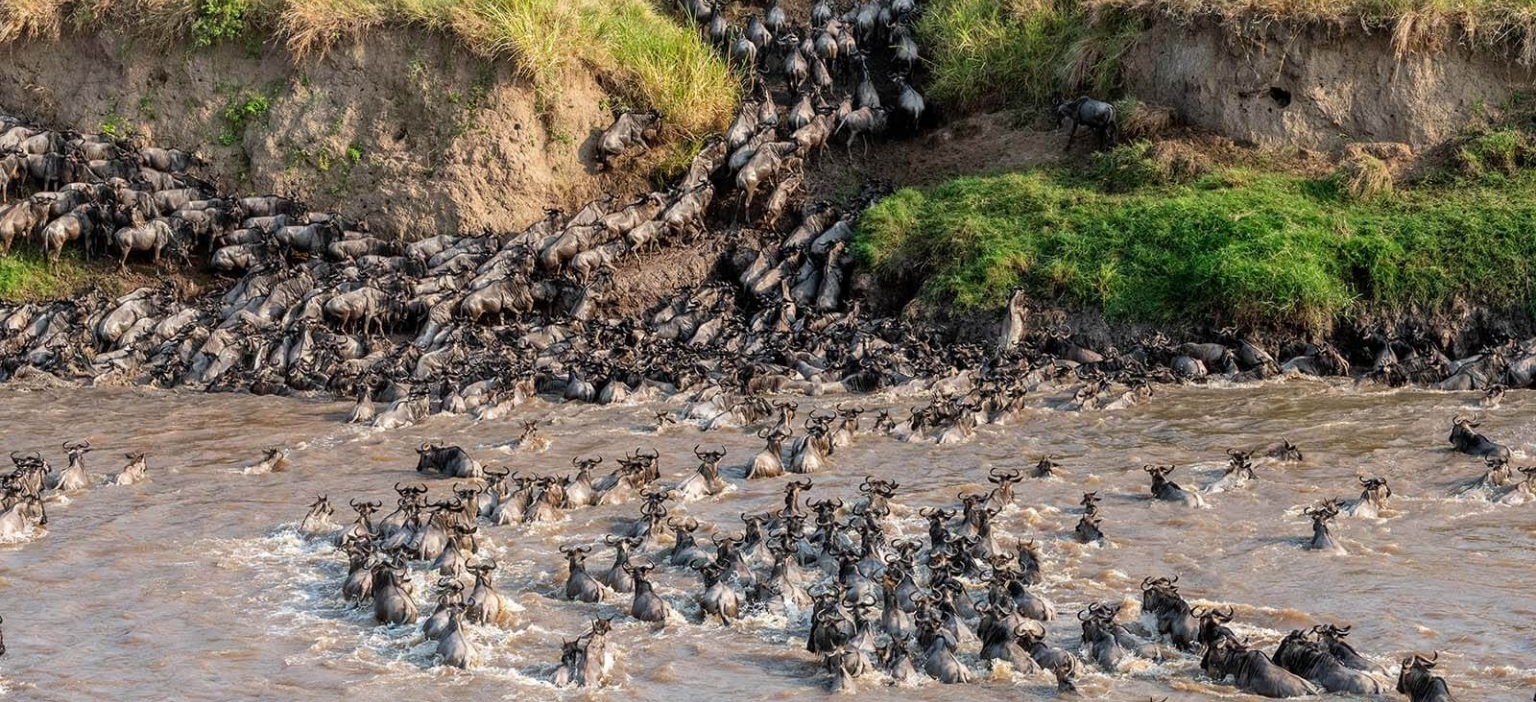
A Mara River crossing happens when the Serengeti-Mara wildebeest herds, with zebra among them, cross the Mara River inside the Masai Mara, and the usual window to see one in Kenya is late July to September. The timing moves with rain and grass, and nobody can promise a crossing on a given day, so the best way to see a wildebeest river crossing is to stay in the right part of the reserve in the right months and allow several full days. This guide covers the months, the named crossing points, how a crossing day works and how many days to allow, and it sits inside our complete Masai Mara safari guide.
The herd is one population that circulates between the southern Serengeti in Tanzania and the Masai Mara in Kenya, and it spends only part of the year on the Kenyan side. While it is there it moves back and forth across the Mara River, and a Great Migration river crossing begins when animals that have been gathering on a bank finally commit to the water.
Planning this trip? Get a free quote in 6 hours →
Mara River Crossing at a Glance
| Question | Answer |
|---|---|
| Months the herds are usually in the Mara | About July to October |
| Busiest months for crossings | Late July to September |
| Where | The Mara River, in the Masai Mara National Reserve in Narok County. The river is 395 km (245 miles) long, rises on the Mau Escarpment, crosses into Tanzania and drains into Lake Victoria |
| Herd size | Estimates range from about 0.5 million to 1.4 million, depending on how the herd is counted |
| How long a crossing lasts | It varies. At Entim, one operator guide reports crossings that run for hours and sometimes three days |
| Can a crossing be guaranteed? | No. Allow several full days and expect some waiting |
If you want to plan around the window, our 7 Days Maasai Mara Migration Safari is from USD 4,500 per person. Prices depend on season, group size and lodge choice.
When Do Mara River Crossings Happen?
Herds are usually in the Mara from about July to October, with the busiest river-crossing action from late July to September. Kenyan officials describe mid-July to October as the usual period for the migration into the Mara, and one operator guide names late July to September as the best window for crossing sightings. If you are asking about the best time to see a river crossing, that is the answer, with one caveat: it is a window, not a timetable.
| Months | What the herds are doing |
|---|---|
| January to March | Calving on the short-grass plains of the south-east Serengeti in Tanzania, far from the Mara |
| May to June | Herds move north-west toward the Grumeti River area and stay until late June. Kenyan researchers say they usually leave the Serengeti around May, after Kenya’s long rains |
| Mid-June | Early arrivals in the Mara are possible in years of ample rain in Kenya |
| July | Crossings of the Grumeti and Mara rivers begin, and herds start to move into Kenya |
| Late July to September | Herds are in Kenya for the dry season, and this is the best window for Mara River crossings |
| October | Herds are usually still in the Mara and begin to return south |
| November to December | Herds head south again with the short rains and usually reach the south by December |
For where the herds are in every month, see our Great Migration month by month guide, or the wider Great Migration safari guide for Kenya and Tanzania.
Why a Crossing Is Hard to Predict
Rain and grass drive the herds, so the dates change from year to year. One operator guide calls the pattern only somewhat predictable and notes that rainfall and flooding can shift the timing of a crossing and can block some crossings altogether. In 2021 Kenyan scientists said the migration was delayed significantly after drier-than-usual weather, and the tourism minister of the day said the herds were still in Tanzania. The practical lesson is to plan for the middle of the window and to build in extra days instead of betting on one date.
Where the Crossings Happen: Named Crossing Points
Operators give the crossing points on the Kenyan side of the river names and numbers, but the names and numbers differ between operators and maps, and we found no official list from the reserve authorities. Treat the table below as one operator guide’s list, not a standard.
| Crossing | Where it is and what to expect |
|---|---|
| Sand River crossing (Kenya crossing 1) | South-east. Less dramatic, because the river there is usually dry and shallow |
| Crossing 2 | Leads into the Mara Triangle. The same guide also names Purungat, Peninsula, Fig, U, Look-out and Miti Moja |
| Crossing 3, “BBC Crossing” | Best viewed from the western bank, the Mara Triangle side |
| Crossing 4, Entim | Central and isolated. Crossings can run for hours, sometimes three days |
| Crossing 5 | Just south of Serena Lodge. Not heavily used |
| Crossing 6, Mawe Mawe | Heavily used, with many crocodiles |
| Crossing 7, Cul de Sac (Kaburu) | Crossings occur through almost the whole crossing season |
| Crossing 8, Pontoon | Next to Mawe Mawe. Only a handful of vehicles can reach it |
The Mara Triangle and the Central Reserve
The Mara Triangle is the south-western part of the reserve, west of the Mara River, covering about 510 square kilometres. It is managed by the not-for-profit Mara Conservancy on behalf of the county government, while the rest of the reserve, the Narok sector, is run by the Narok County Government. Which bank gives the better view depends on where the herds cross that week, so a good guide moves between points.
Crossings also happen on the Tanzanian stretch of the same river, and the herds move between the two countries during the season. This article covers the Kenyan side.
Where to Stay and How Many Days to Allow
Where you sleep decides how long the drive to the river is each morning, and you want to be in position early. Ask each camp how far it is from the river and whether it sits on the east or west bank before you book. We do not name camps here because where the herds cross changes with the season; tell us your dates and we suggest camps to suit.
A crossing is a matter of odds, so more days at the right time means better chances. As a rule of thumb, we suggest at least three full days in the Mara in the crossing season, and more if your dates sit at the edge of the window. Our migration trips run from five to eight days. The 5 Days Masai Mara Migration Safari is from USD 2,750 per person and the 8 Days Migration Majesty Safari is from USD 5,840 per person. When you compare quotes, check how many nights fall in the Mara, since that is the number that counts for crossing chances.
Two trips built around the migration
7 Days Maasai Mara Migration Safari: suits travelers who want a full week built around the herds. From USD 4,500 per person.
5 Days Masai Mara Migration Safari: suits travelers with less time who still want to be in the Mara for the crossing season. From USD 2,750 per person.
Prices depend on season, group size and lodge choice.
How a Mara River Crossing Day Works
Mostly Waiting
Most of a crossing day is waiting. Your guide chooses a point from where the herds are massing, and you arrive early with a packed lunch and settle in. Animals often gather at the bank, walk along it and retreat before anything happens. A crossing can start suddenly after hours of nothing, usually with zebras leading and wildebeest following. It can also fail to happen, which is why the days you allow matter more than the date.
Vehicle Positioning and Ranger Rules
Your guide will park where you can watch without blocking the herd’s approach or its exit from the water, and will keep the engine off once the animals are close. Rules and ranger presence differ between the Narok sector, the Mara Triangle and the conservancies, so follow your guide and any ranger on the spot. Never drive between a herd and the river. A herd that is blocked can turn back, and then everyone waits longer.
What You Will Actually See
Expect dust, noise and a lot of motion in a short time. Animals can be swept off course or injured, and some do not make it across. This is wild behaviour, not a staged show, and some travelers find it hard to watch.
Crocodiles and the Risks
Crocodiles waiting in the river are part of what makes the Mara River crossings a safari attraction, and Mawe Mawe is reported to have many. They are not the only risk, because the river itself is a hazard. Wikipedia estimates that about 250,000 wildebeest die on the roughly 800 km (500 miles) journey from Tanzania to the Masai Mara, from thirst, hunger, exhaustion and predation, but that is a whole-journey figure and not a count of river deaths.
Photography Tips for a River Crossing
- Bring your longest lens, plus a wider one for the river, the dust and the size of the herd.
- Use burst mode and a fast shutter speed, because the action is quick.
- Focus on the water’s edge and the likely exit bank before anything starts, and watch the lead zebras for the first sign.
- Rest the lens on a bean bag on the vehicle’s window frame; a tripod rarely works in a safari vehicle.
- Charge batteries and clear memory cards the night before, and carry a lens cloth for dust.
Etiquette: Watching Without Spoiling the Crossing
- Keep vehicles back from the bank and never park between the herd and the water.
- Switch off the engine, keep voices low and avoid sudden movement.
- Stay in the vehicle and do not throw or drop anything.
- Do not crowd a point. If you have had a long view, let another vehicle move in.
Get your free safari quote in 6 hours
Tell us your dates and who is travelling. A planner in our Nairobi office replies within 6 hours with a day-by-day itinerary, the camps we suggest and a fully itemised price. No payment is needed to enquire.
Prefer to talk? WhatsApp or call +254 799 871 255.
Frequently asked questions
When is the best time to see a Mara River crossing?
Late July to September is the busiest window, inside a longer period from about July to October when the herds are usually in the Mara. Dates move with the rains, so see our guide to the best time to visit the Masai Mara, month by month before you fix your travel dates.
Can you guarantee a wildebeest river crossing?
No. Nobody can, because the herds follow rain and grass, not a calendar. What you can control is the month and the number of days you allow in the Mara.
How many days do I need to see a crossing?
As a rule of thumb we suggest at least three full days in the Mara in the crossing season, and more if your dates sit at the edge of the window. Our migration trips run from five to eight days, so check how many nights fall in the Mara for your dates.
Where is the best place to see a Great Migration river crossing?
It depends on where the herds are that week. Mawe Mawe and Cul de Sac are described as heavily used or used through most of the season, the BBC Crossing is best viewed from the Mara Triangle side, and Entim can run for hours.
How many wildebeest are there?
Estimates range from about 0.5 million to 1.4 million. The traditional aerial count, flown in March 2023, found 1,366,109 wildebeest with a wide margin of error. A 2025 satellite study counted 502,917 to 533,137 in August 2023 imagery and says the long-quoted 1.3 million figure is too high. The counts were made at different times of year, so read both as estimates.
Do crocodiles wait at every crossing?
Not at every one. Mawe Mawe is reported to have many crocodiles, while the Sand River crossing is usually dry and shallow and therefore less dramatic.


Comments are closed