
 Safari, Wildlife & Conservation
The Great Migration is a loop that runs all year. The herds calve on the southern Serengeti plains in Tanzania from January to March, move north-west from about May, and are usually in Kenya’s Masai Mara from about July to October before they head back south. This guide shows where the herds usually are in each month and why the dates move, and it sits alongside our Masai Mara safari guide.
Treat every date below as a usual pattern, not a promise. Rain and grass decide where the herds are, and the timing can shift by weeks from one year to the next. If your dates fall between July and October, our 5 days Masai Mara Migration Safari is the Kenya option to look at first.
Planning this trip? Get a free quote in 6 hours →
Great Migration at a glance
| Question | Short answer |
|---|---|
| What is it? | One large population of wildebeest, with zebras and gazelles alongside, that circulates between the southern Serengeti (Tanzania) and the Masai Mara (Kenya) |
| Usual months in the Mara | About July to October. In years of ample rain in Kenya, the first herds can arrive in mid-June |
| Calving | January to March on the southern Serengeti plains in Tanzania, with most births in February |
| River crossings | Busiest from late July to September |
| Herd size | Estimates range from about 0.5 million to 1.4 million wildebeest, depending on the method |
| Length of the journey | Roughly 800 km (500 miles) from Tanzania to the Mara, by one widely quoted figure |
| What changes it | Rainfall and grass, so the timing differs every year |
The Great Migration month by month
The table follows the herds around the loop. It uses the usual pattern, so read each row as a window of a few weeks either side.
| Month | Where the herds usually are | What is happening | Country | Base to consider |
|---|---|---|---|---|
| January | Southern Serengeti short-grass plains | Calving begins late in the month | Tanzania | Southern Serengeti (Ndutu area) |
| February | Southern plains | Most births happen this month | Tanzania | Southern Serengeti (Ndutu area) |
| March | Southern plains, where the whole herd gathers by the end of the month | Calving season ends; the long rains start to arrive | Tanzania | Southern Serengeti |
| April | Mostly still in the south | Peak of the long rains | Tanzania | Southern Serengeti |
| May | Moving north-west toward the Grumeti River area | Herds leave the southern plains after the long rains | Tanzania | Grumeti River area |
| June | Around the Grumeti River area until late June | Early arrivals in the Mara are possible from mid-June if Kenya has had ample rain | Tanzania, sometimes Kenya | Grumeti River area |
| July | Moving into the northern Serengeti and the Mara | Grumeti and Mara river crossings begin; most years the herds reach the Mara from mid-July | Tanzania and Kenya | Northern Serengeti or the Mara |
| August | The Mara and the northern Serengeti | Dry season in Kenya; river crossings are busy | Kenya, with some herds still in Tanzania | Masai Mara |
| September | The Mara | Crossings continue through the month | Kenya | Masai Mara |
| October | The Mara, then heading south | The herds usually start back toward Tanzania around October | Kenya, then Tanzania | Masai Mara |
| November | Heading south | The short rains arrive and the herds move south again | Kenya and Tanzania | Northern Serengeti or the Mara |
| December | Usually back on the southern plains | Short rains; the herds usually reach the south this month | Tanzania | Southern Serengeti (Ndutu area) |
June, July, October and November are the months to be most careful with. The herds are in transit, and a few weeks of difference in the rains can put them on the other side of the border.
Why the dates move from year to year
The herds follow rain and fresh grass, and neither arrives on a fixed date. One operator guide describes the pattern as only somewhat predictable, and notes that rainfall and flooding can change when a herd crosses the Mara River, and can block some crossings altogether.
The 2021 season shows how far it can slip. Kenyan scientists said the migration was delayed that year, pointing to weak March to May rains and dry, cold weather from June to August, and Kenya’s Tourism Cabinet Secretary at the time said the herds were still in Tanzania. In a wetter year the opposite can happen, with early arrivals from mid-June.
The practical advice is to choose a window, not a date. If you want herds in Kenya, the middle of the July to October range gives the best chance. Give each area a few nights so a late or early herd does not cost you the whole trip. Our longer Great Migration safari guide covers the same ground in more depth.
Which months are in Kenya and which in Tanzania
The border is a line on a map, not a barrier for the herds. The Tanzanian wildlife research institute treats the Serengeti and the Masai Mara reserve, with its surrounding conservancies, as one ecosystem. As a rule of thumb:
- Tanzania: roughly November or December to June. The herds are on the southern plains for calving, then move north-west toward the Grumeti River area.
- Kenya: roughly July to October, with the busiest river-crossing action from late July to September.
- Both: the transition months. The herds crisscross the Mara River, so animals can be on either side in the same week.
If you are weighing the two countries against each other, see Masai Mara vs Serengeti: one ecosystem, two countries.
Calving season: January to March in Tanzania
The wildebeest give birth on the short-grass plains of the south-east of the Serengeti. The season runs from January to March, with most births in February. One source gives up to about 500,000 calves in two to three weeks, and other figures are lower, so treat any single number with care. Ndutu and the southern Serengeti are in Tanzania, not the Mara, so a calving trip is a Tanzania trip.
For the full story, read our guide to wildebeest calving season. If you want to plan around it, our 10 Day Tanzania’s Calving Season Safari starts from USD 5,910 per person.
Mara River crossings: July to September
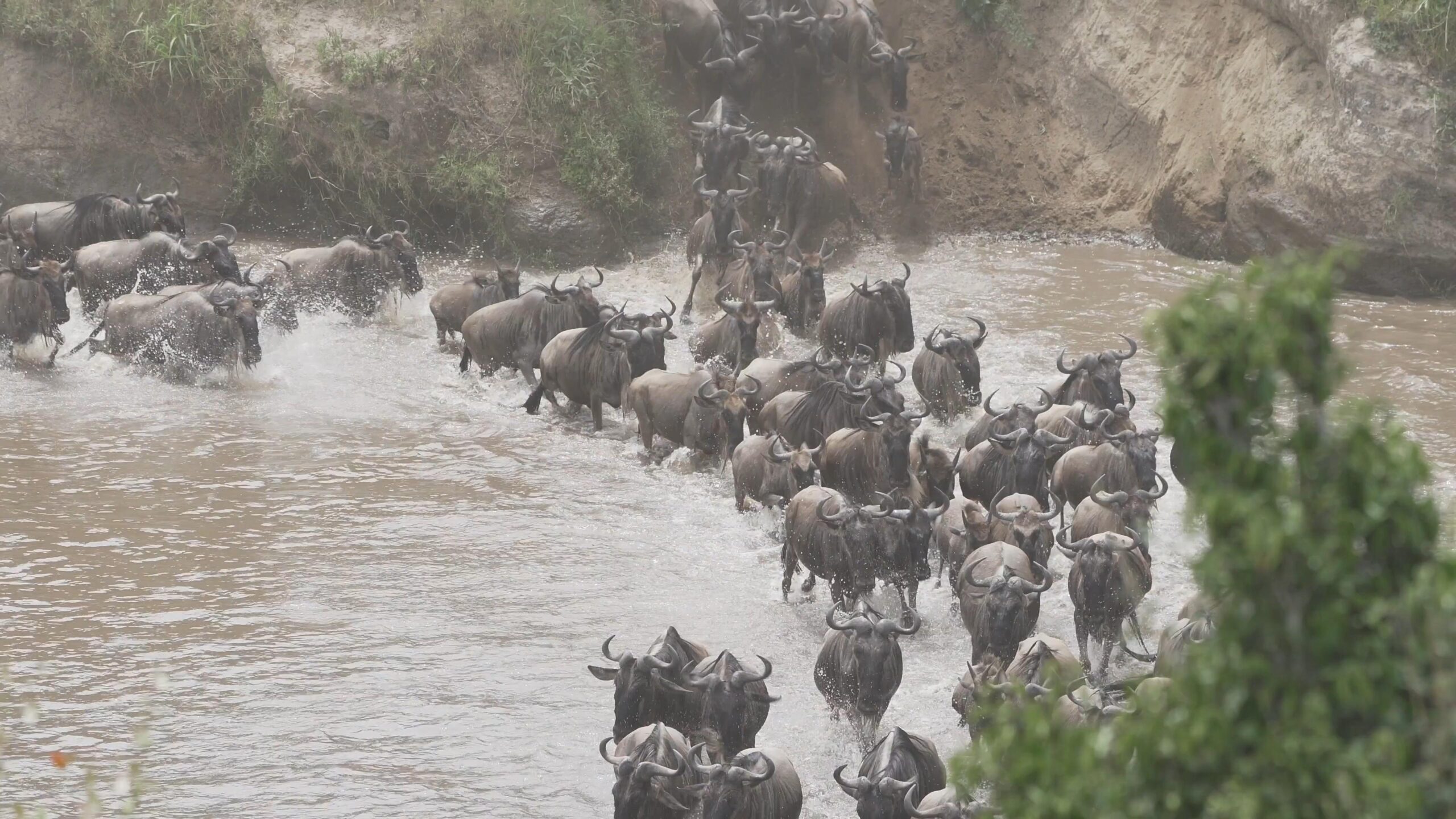
The crossings begin in July, as the first herds reach the river, and the best window for seeing them is generally given as late July to September. Zebras usually lead and the wildebeest follow, while crocodiles wait in the water. Crossing points are named and numbered differently by different operators and maps, and some are far busier than others.
A crossing cannot be scheduled. The herds may gather at the bank for hours or days before they commit, and a swollen river can stop them. Our guide to Mara River crossings: when, where and how to see one goes through the odds and what to do to improve them.
Two ways to follow the herds
5 days Masai Mara Migration Safari: suits travellers who want to see the migration in the Masai Mara. From USD 2,750 per person.
10 Day Tanzania’s Calving Season Safari: suits travellers who want to be in Tanzania for the calving season. From USD 5,910 per person.
From-prices are per person for a midrange trip in low season with two sharing. Prices depend on season, group size and lodge choice, and are likely to be higher in the busiest migration months.
How many animals are in the Great Migration?
Nobody agrees on one number. The official count is an aerial survey by the Tanzania Wildlife Research Institute (TAWIRI), flown in March 2023, when the whole herd is on the southern plains. A 2025 study from Oxford, Princeton and other institutions counted wildebeest on satellite images from August, when the herds are in the northern Serengeti and the Mara.
| Count | Method | Wildebeest |
|---|---|---|
| March 2023 | TAWIRI aerial survey | 1,366,109, plus or minus 231,741 |
| August 2022 | Satellite imagery and AI | 324,202 to 337,926 |
| August 2023 | Satellite imagery and AI | 502,917 to 533,137 |
The satellite authors say their numbers may be slightly high, because the models cannot reliably tell wildebeest from zebra and eland. TAWIRI says its own method needs further improvement in accuracy. A fair summary is that estimates range from about 0.5 million to 1.4 million. For a traveller, the herd is vast in any case. What you control is the month and the place.
Weather and what to pack
The Mara has two rainy seasons. The long rains run roughly from March to May and peak in April, and the short rains run roughly from November to December. June to October is drier, though showers are still possible. The reserve sits at roughly 1,500 to 2,100 m, which is why mornings and evenings feel cold so close to the equator.
- A fleece or warm jacket for dawn game drives, even in the July to October season
- A light rain jacket for November to May
- Layers you can remove as the day warms up
- Binoculars and a camera with a long lens for distant river crossings
- Sun hat and sunscreen for the open plains
Choosing the month that suits you
| If you want | Aim for | Where | Country |
|---|---|---|---|
| Newborn calves | February, with January and March either side | Southern Serengeti | Tanzania |
| River crossings | Late July to September | Mara River, both banks | Kenya and Tanzania |
| The best chance of herds in Kenya | August and September | Masai Mara | Kenya |
| Both countries in one trip | Ask us to match the order to your month | Serengeti and the Mara | Tanzania and Kenya |
If you want both sides, our 21-Day Kenya and Tanzania Safari with Zanzibar starts from USD 9,050 per person, and we can adjust the order of parks to your month. Prices depend on season, group size and lodge choice.
Get your free safari quote in 6 hours
Tell us your dates and who is travelling. A planner in our Nairobi office replies within 6 hours with a day-by-day itinerary, the camps we suggest and a fully itemised price. No payment is needed to enquire.
Prefer to talk? WhatsApp or call +254 799 871 255.
Frequently asked questions
What is the best month to see the Great Migration?
There is no single best month, because the herds are somewhere on the loop all year. For Mara River crossings, aim for late July to September. For newborn calves, aim for February on the southern Serengeti plains in Tanzania. Decide which scene matters most to you, then use the table above to pick the month.
Where is the Great Migration now?
Look up the current month in the table for the usual position, then allow for the year. Rain moves the herds, so the table is a guide and not a live tracker. For a trip you are planning, ask the camps and guides near your dates for the latest reports before you commit.
Is the Great Migration in Kenya or Tanzania?
Both. The herd is one population that circulates between the southern Serengeti in Tanzania and the Masai Mara in Kenya. Tanzania has the herds for most of the year, and Kenya usually has them from about July to October.
Can I see the Great Migration in June?
Mostly in Tanzania. In June the herds are usually around the Grumeti River area. In years when Kenya has had ample rain, early arrivals can reach the Mara by mid-June, but the more usual start is July.
How many wildebeest are in the Great Migration?
Estimates range from about 0.5 million to 1.4 million, depending on whether you trust the aerial survey or the satellite study. Even the lowest estimate describes a very large herd.
Is a river crossing guaranteed?
No. Herds decide when to cross, rain and flooding can change the timing, and some crossing points are quiet in some years. Spend several days in the Mara in the late July to September window, and read our guide to Mara River crossings for tips on where to wait.


Comments are closed