
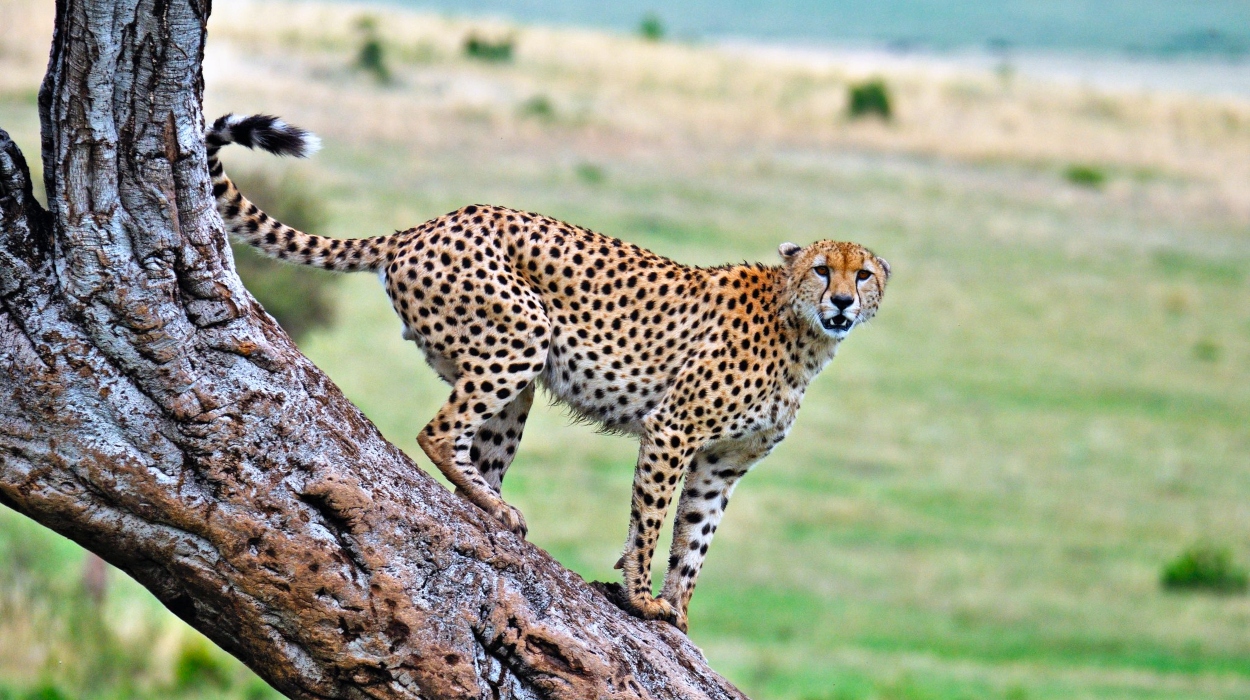
 Safari, Wildlife & Conservation
For a Masai Mara cheetah, look on the open, short-grass plains and in the quieter conservancies; for a Masai Mara leopard, look along wooded river lines, in thickets and among large trees, including in the Mara Triangle. Both cats are scarcer than lions: the Mara Predator Conservation Programme counted 16 resident adult cheetahs in its 2,713 km² study area in 2025, and a 2019 camera-trap study in the Mara Triangle put leopard density at about 1.9 per 100 km². Our Masai Mara safari guide covers the reserve as a whole; this page is about these two cats.
Neither cat can be promised on any safari. What you can control is where you stay, how many game drives you give the search and how your vehicle behaves at a sighting. A short trip such as the 3-Day Maasai Mara Roar & Roam Safari gives you a realistic first look, and a longer stay gives the cats more chances to show themselves.
Planning this trip? Get a free quote in 6 hours →
Cheetah and leopard at a glance
| Feature | Cheetah | Leopard |
|---|---|---|
| Habitat | Open, short-grass plains | Wooded river lines, thickets, rocky ground, large trees |
| Where to start | Open plains and conservancy grassland | The Mara and Talek rivers, the Mara Triangle, conservancy woodland |
| Most active | In daylight, mainly early and late | From dusk to dawn; often resting in a tree by day |
| Social life | Females alone or with cubs; males often in small groups | Solitary |
| Latest research figure | 16 resident independent adults in a 2,713 km² study area (2025) | About 1.9 per 100 km² in the Mara Triangle (2019) |
Cheetahs in the Masai Mara
Where to find them
A Masai Mara cheetah hunts by sight in daylight, so it favours open ground with a long view. Scan the short-grass plains for a slim shape sitting upright on a termite mound, a fallen log or a low rise. Both the reserve’s plains and the conservancies’ grassland are worth your game drives, and the conservancies often have fewer vehicles at a sighting, which gives a hunting cheetah more room.
How many are there?
The most recent hard figure comes from the Mara Predator Conservation Programme. Its 2025 survey counted 16 resident independent adult cheetahs in a 2,713 km² study area (0.6 per 100 km²), up from 12 in 2024. That count leaves out transient and part-time residents, and the report says the number of cheetahs using the Mara over a full year is much higher. It still calls the resident population “concerningly low”, with too few adult females, so a single disease outbreak could change the picture quickly.
The practical point is that a cheetah sighting is a privilege. A crowd of vehicles can cost a cheetah its hunt, so a calm, patient guide matters as much as good eyes.
Leopards in the Masai Mara
Where to find them
A Masai Mara leopard is solitary and secretive, and it rests in trees or thick cover for much of the day. Wikipedia notes that leopards live anywhere in the reserve where there are trees to climb, so your best odds are along wooded river lines such as the Mara and Talek rivers, in thickets and in the Mara Triangle. Scan the larger branches for a hanging tail or paw, and watch where other vehicles gather. Night drives in the conservancies open up the hours when leopards are most active. The leopard is also one of the Big Five; our article on the Big Five in the Masai Mara covers the rest.
How many are there?
We found no verified reserve-wide leopard count. The best figure is local: a 2019 camera-trap study in the Mara Triangle (34 camera stations over 63 nights) estimated 1.90 leopards per 100 km², plus or minus 0.56 (Tolhurst and colleagues, African Journal of Ecology, 2025). For scale only, the lion survey found 14.67 lions per 100 km² in the Triangle in 2025. The years, methods and age groups differ, so this is not a like-for-like comparison, but it helps explain why leopards are seen less often than the lions of the Masai Mara.
How to tell a cheetah from a leopard
Both are spotted, and first-time visitors often mix them up. Check the markings first, then the build and the setting.
| Feature | Cheetah | Leopard |
|---|---|---|
| Markings | Solid black spots | Rosettes, which are rings of spots |
| Face | Black “tear lines” from eye to mouth | No tear lines; broad face |
| Build | Slim, long legs, small head | Stocky, short legs, heavy head and shoulders |
| Setting | Open plains, mounds, low rises | Trees, river lines, rocky ground |
| Behaviour | Hunts by day with a sprint | Stalks and ambushes, mostly at night |
Planning your cat safari: timing, length and cost
Time of day and season
Early morning and late afternoon give the best mix of active cats and soft light. Cheetahs hunt in daylight, so a morning drive on the plains is the standard way to look for them, while dawn, dusk and conservancy night drives suit leopards. Season matters too: shorter grass in drier months can make cheetahs easier to see, and tall grass after rain can hide them. Tell us your dates and we will say what to expect.
How long to stay
As a rule of thumb, plan at least three full days in the Mara if cats are your priority. A conservancy camp adds night drives and off-road viewing, and at least one day in the reserve or the Triangle covers the open plains. The 9 Day The Big Cat Safari is built for travellers who want that extra time.
What it costs
The 3-day trip starts from USD 1,420 per person and the 9-day trip from USD 4,197 per person, based on midrange accommodation in low season with two people sharing. Prices depend on season, group size and lodge choice. A dawn hot-air balloon flight over the Masai Mara is an optional extra at USD 550 per person; it shows you the plains well, though leopards hide under trees.
Two trips to start from
- 3-Day Maasai Mara Roar & Roam Safari suits travellers short on time who want a first look at the Mara. From USD 1,420 per person.
- 9 Day The Big Cat Safari suits travellers who want several days to look for big cats. From USD 4,197 per person.
Prices depend on season, group size and lodge choice.
Why conservancies help with cheetahs and leopards
Conservancies are areas of community-owned land beside the reserve, leased for tourism. Landowners receive a lease fee or a share of profits. Only guests staying at member camps may game-drive in a conservancy, and self-driving is not permitted. The rules differ from the reserve in ways that matter for cats.
| Rule | Masai Mara National Reserve | Conservancies |
|---|---|---|
| Off-road driving | Not permitted; marked tracks only | Offered, under each conservancy’s own rules |
| Night drives | Not permitted | Offered |
| Walking safaris | Not permitted | Offered, led by an armed ranger |
| Vehicles at a sighting | Mara Triangle: five, set by the Mara Conservancy | Mara North: five. Mara Naboisho: four, according to a travel company |
Mara North Conservancy’s published etiquette shows how this works in practice. Extra vehicles wait 100 metres away, and each vehicle has 10 minutes at a sighting before giving way. Vehicles stay on the track unless they are viewing wildlife; for the Big Five, which includes the leopard, a vehicle may leave the track by the shortest route and keep 20 metres from the animal. Night drives run in designated areas with red filters, and vehicles must be back at camp by 10 pm. Other conservancies set their own rules, so ask your camp.
None of this guarantees a sighting. The reserve’s plains and the Mara Triangle are productive too, and a good itinerary uses both. Our guide to Masai Mara conservancy camps explains night drives, walks and what to expect from each camp.
Get your free safari quote in 6 hours
Tell us your dates and who is travelling. A planner in our Nairobi office replies within 6 hours with a day-by-day itinerary, the camps we suggest and a fully itemised price. No payment is needed to enquire.
Prefer to talk? WhatsApp or call +254 799 871 255.
Frequently asked questions
Can I see both a cheetah and a leopard on one safari?
Yes, it is possible, but never guaranteed. Cheetahs favour open plains and leopards favour wooded river lines, so an itinerary that covers both habitats and gives you several game drives raises your chances.
Where is the best place to see a leopard in the Masai Mara?
Start along the wooded Mara and Talek river lines, in thickets and in the Mara Triangle, and consider a conservancy camp for night drives. No source ranks one spot as the best; your guide’s knowledge of recent sightings counts for most.
Are cheetahs rare in the Masai Mara?
Resident cheetahs are few. The Mara Predator Conservation Programme counted 16 resident independent adults in its study area in 2025, a figure that leaves out transient cheetahs. The total using the Mara over a year is higher.
Are night drives allowed in the Masai Mara?
Not in the reserve. Conservancies offer them, subject to their own rules; at Mara North they run in designated areas with red filters and end at camp by 10 pm.
Is a conservancy better than the reserve for big cats?
Not automatically. Conservancies offer fewer vehicles, off-road viewing, night drives and walks, while the reserve has wide plains that suit cheetahs. Combining a conservancy camp with a reserve day is a sensible way to cover both.
What should I bring to spot big cats?
Bring binoculars, a camera with a long lens, neutral-coloured clothing, a hat and warm layers for early mornings. Ask your camp what else it recommends for night drives.


Comments are closed