 Destinations, Experiences & East Africa Travel
The Masai Mara, officially the Maasai Mara National Reserve, covers 1,510 km² (about 583 sq mi) of Narok County in south-western Kenya. It stands at roughly 1,500 to 2,180 m above sea level and runs straight into Tanzania’s Serengeti National Park.
It holds all of the Big Five, 481 lions over one year old in the 2025 survey, more than 500 bird species and a wildebeest herd that is usually in the Mara from about July to October. This list gathers interesting facts about the Masai Mara, from fun facts about its name to hard numbers on lions and rhinos, and it sits alongside our complete Masai Mara safari guide.
Planning this trip? Get a free quote in 6 hours →
Masai Mara at a glance
| Topic | Figure |
|---|---|
| Official name | Maasai Mara National Reserve |
| Location | Narok County, south-western Kenya |
| Reserve area | 1,510 km² (about 583 sq mi) |
| Altitude | Roughly 1,500 to 2,180 m (4,920 to 7,150 ft) |
| Neighbour | Tanzania’s Serengeti National Park, which it touches |
| Main river | Mara River, 395 km long |
| Big Five | All five, including black rhino |
| Lions, 2025 survey | 481 over one year old, in a 2,713 km² study area |
| Black rhinos | Roughly 50 to 60, according to recent monitoring |
| Birds and mammals | More than 500 bird species; more than 95 mammal species |
| Wildebeest | Estimates range from about 0.5 million to 1.4 million |
| Herds usually in the Mara | About July to October |
| Optional hot-air balloon with Entice | USD 550 per person |
Want to see it for yourself? Our 3-Day Maasai Mara Roar & Roam Safari starts from USD 1,420 per person. Prices depend on season, group size and lodge choice.
25 Masai Mara facts
Where two sources disagree, we give a range and say so.
Place and size
- The name means “spotted”. “Mara” is the Maa word for spotted, a nod to the short bushy trees that dot the landscape, while “Maasai” refers to the Maasai people.
- The reserve covers 1,510 km². That is about 583 sq mi, and it is only part of the wider Mara (see fact 8).
- Two managers share it. The Narok sector is run by the Narok County Government, and the Mara Triangle by the not-for-profit Mara Conservancy under contract on behalf of the county government.
- It sits high. At roughly 1,500 to 2,180 m (4,920 to 7,150 ft), early morning game drives can be cool, so pack a warm layer.
- It continues into Tanzania. The reserve is contiguous with the Serengeti National Park, and the wildebeest herd treats the two as one range.
- The Mara River is 395 km long. It rises on the Mau Escarpment at about 3,000 m (9,800 ft), runs through the reserve and the Serengeti, and drains into Lake Victoria. Its Sand and Talek tributaries are the other main rivers draining the reserve.
- The Mara Triangle covers 510 km². This south-western part of the reserve lies west of the Mara River, with the Oloololo Escarpment, about 400 m high, along its north-western border.
- The wider Mara is much bigger than the reserve. The Mara Predator Conservation Programme studies an area of more than 3,000 km², a research definition rather than an official boundary, across 18 named areas: the reserve, the Mara Triangle and 16 conservancies or conservation areas. Nature Kenya says about 70 per cent of the wildlife of the wider ecosystem lives outside the gazetted reserve.
Wildlife
- All of the Big Five live here. Lion, leopard, elephant, buffalo and black rhino can all be seen in the Mara.
- About 481 lions live in the study area. The 2025 lion survey counted 481 lions over one year old in a 2,713 km² area covering the reserve and surrounding conservancies, up from 465 in 2024. That is 17.5 lions per 100 km², and it leaves out cubs.
- Some conservancies are denser still. Ol Kinyei (28.56 lions per 100 km²), Naboisho (25.01) and Olare-Motorogi (21.98) all passed 20 in 2025. The researchers also found about 3.3 females per male, up from 1.7 in 2024, and flagged the shortage of adult males as a concern.
- Black rhinos once fell to 18. Wikipedia, citing the Mara Conservancy, gives 120 black rhinos in 1971 and 18 in 1984.
- Black rhinos are recovering. Recent monitoring points to roughly 50 to 60, and the Sheldrick Wildlife Trust gave a current population of 57 in March 2026. The Mara is one of only two remaining native eastern black rhino populations living unfenced, and more than three-quarters of its rhinos are now ear-notched and identifiable.
- Cheetahs are few. The 2025 survey found 16 resident independent adult cheetahs, up from 12 in 2024, and the researchers describe that as low. The count leaves out cheetahs passing through, so the number using the Mara over a year is higher.
- Leopards live wherever there are trees. A 2019 camera-trap study in the Mara Triangle estimated 1.90 leopards per 100 km². That is a local figure, not a reserve-wide count.
- There are more than 95 mammal species. That is the figure Nature Kenya gives, from 2017.
- More than 500 bird species have been recorded. The list includes vultures, marabou storks, secretary birds, hornbills and crowned cranes, and the lilac-breasted roller, which Wikipedia lists as Kenya’s national bird.
- The Marsh Pride is tied to a TV series. It is linked to Musiara Marsh and to the BBC series Big Cat Diary. In December 2015, five of its lions ate a poisoned cow carcass, two died and three were treated, and at least two people were arrested.
The Great Migration
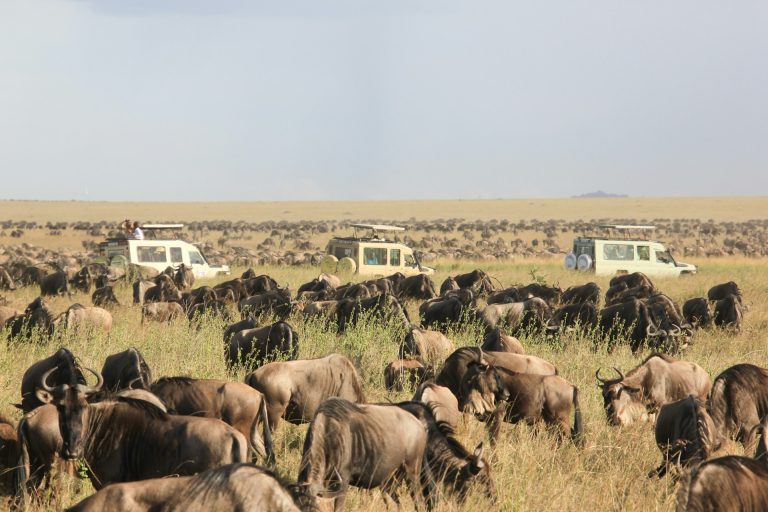
- Nobody agrees on the herd size. A TAWIRI aerial count flown 28 to 31 March 2023 gave 1,366,109 wildebeest, plus or minus 231,741. A 2025 satellite and AI study counted 502,917 to 533,137 in August 2023 imagery.
- The two counts were taken in different places. The aerial count was flown in March, when the herd is on the southern Serengeti plains, and the satellite images are from August, when it is in the northern Serengeti and the Mara. That may explain part of the gap, and both teams say their methods have limits.
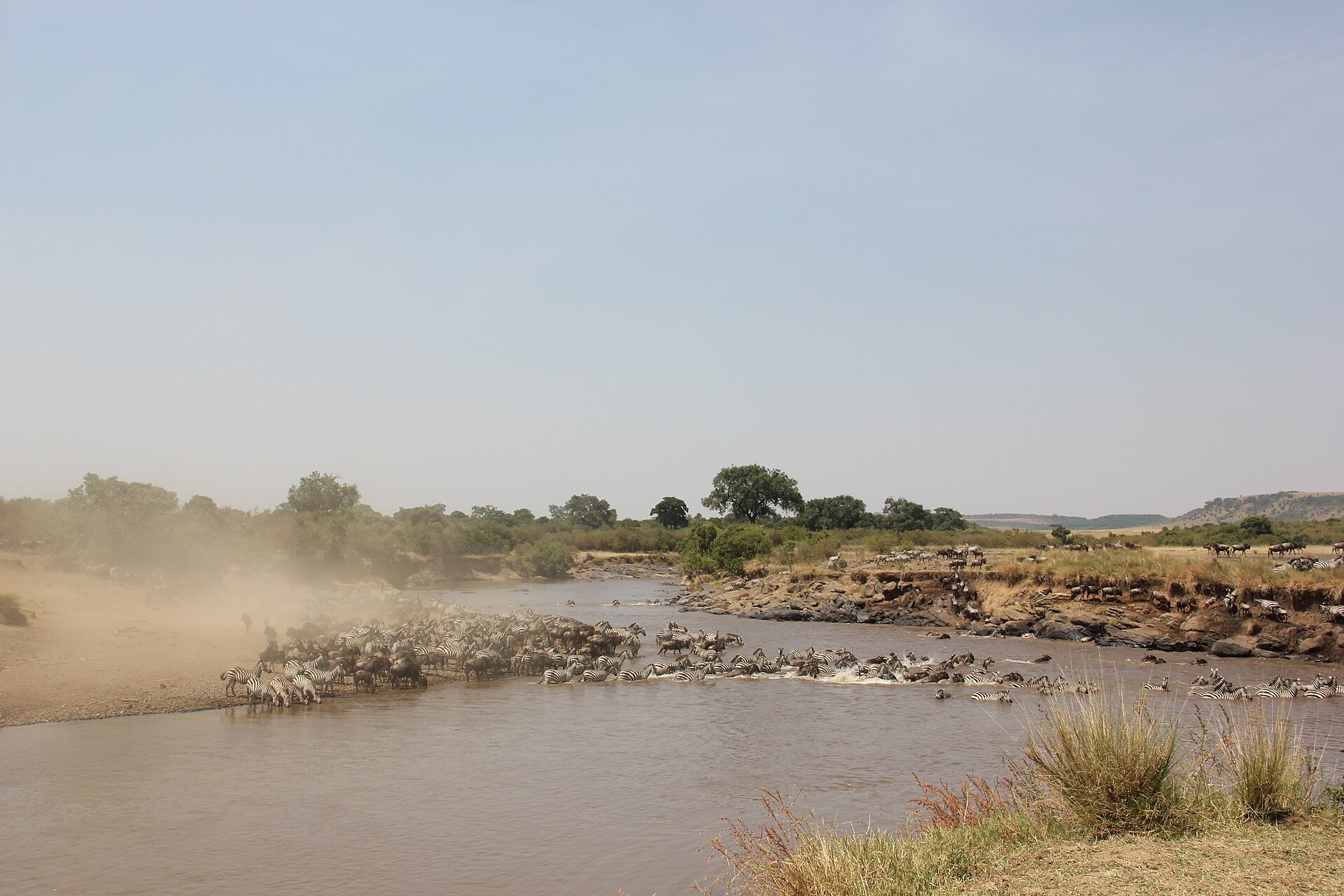
- The herds are usually in the Mara from about July to October. The busiest river-crossing action runs from late July to September. Arrivals can start in mid-June in wet years, and in 2021 drier conditions delayed the herds, so timing is never guaranteed.
- Calving happens in Tanzania, not the Mara. The wildebeest calve on the south-eastern Serengeti plains from January to March, mostly in February, so a July to October trip will not catch it.
- Zebras usually lead the crossings. Wildebeest follow, and crocodiles wait in the river. Crossing points have names such as Sand River, Mawe Mawe and Pontoon, but operators and maps number them differently.
Visiting
- Visitor numbers have fallen. The Kenya National Bureau of Statistics reports 420,000 visitors to the Maasai Mara in 2023, 343,000 in 2024 and 213,000 in 2025, according to Business Daily.
- You can float over it. Hot-air balloon flights are an optional extra on an Entice Masai Mara safari, at USD 550 per person.
Lion numbers by area, 2025
These figures come from the same survey as fact 10. The Mara Triangle has its own row, separate from the reserve’s main unit.
| Area | Lions over one year old | Lions per 100 km² |
|---|---|---|
| Ol Kinyei Conservancy | 19 | 28.56 |
| Naboisho Conservancy | 52 | 25.01 |
| Olare-Motorogi Conservancy | 32 | 21.98 |
| Mara North Conservancy | 55 | 18.56 |
| Maasai Mara National Reserve unit | 183 | 17.32 |
| Mara Triangle | 72 | 14.67 |
Safaris that fit this guide
 5-Day Masai Mara Migration SafariMore time with the herds in the Mara5 days · from $2,750 ppView trip →
 21-Day Kenya and Tanzania with ZanzibarThe Mara, Serengeti, Ngorongoro and Zanzibar21 days · from $9,050 ppView trip →
 8-Day Samburu and Mara by AirNorthern specials and big cats8 days · from $5,100 ppView trip →
Every trip is private and can be changed to suit you. Get a free, tailor-made quote in 6 hours →
The wildebeest year, month by month
| When | Where the herds usually are |
|---|---|
| January to March | Calving on the south-eastern short-grass plains of the Serengeti, in Tanzania |
| May | Moving north-west toward the Grumeti River area, where they stay until late June |
| Mid-June | Early arrivals in the Mara are possible after ample rain in Kenya |
| July | River crossings begin, and the herds usually move north into the Mara |
| Late July to September | The busiest window for Mara River crossings |
| October | The herds usually start back south |
| Early November to December | Heading south with the short rains, usually back on the southern plains by December |
Rain and grass set the real timing, so treat every month above as a usual pattern and not a promise.
Seeing the Mara with Entice
Our 3-Day Maasai Mara Roar & Roam Safari is the short way in, from USD 1,420 per person based on a midrange lodge, low season, two sharing. Prices depend on season, group size and lodge choice. A Maasai village visit costs USD 30 on this trip, paid on the day, and the optional hot-air balloon flight is USD 550 per person. Fees last verified: October 2026.
Reserve entry fees change from time to time, so check the current figure when you book. We have not listed one here.
Two ways to see the Mara
- 3-Day Maasai Mara Roar & Roam Safari: suits first-time visitors with a short window. From USD 1,420 per person.
- Tailor-made Mara safari: suits anyone who wants more days, a particular month or a different lodge level. Quoted for your dates.
Practical notes before you go
- Want river crossings? Aim for late July to September and keep your dates flexible, because rain moves the herds.
- Want calving? That is a Tanzania experience, from January to March.
- Want lions? The densest numbers in 2025 were in Ol Kinyei, Naboisho and Olare-Motorogi, so ask which area your camp covers.
- Want the basics? Our guide to what the Masai Mara is and why it is famous covers location and size, and the Masai Mara wildlife list covers the animals.
Get your free safari quote in 6 hours
Tell us your dates and who is travelling. A planner in our Nairobi office replies within 6 hours with a day-by-day itinerary, the camps we suggest and a fully itemised price. No payment is needed to enquire.
Prefer to talk? WhatsApp or call +254 799 871 255.
Frequently asked questions
How big is the Masai Mara?
The reserve covers 1,510 km² (about 583 sq mi). The wider Mara is larger: researchers study an area of more than 3,000 km² that includes the conservancies, but that is a research definition and not an official boundary.
Is the Masai Mara the same as the Serengeti?
No. They are separate protected areas, the Mara in Kenya and the Serengeti in Tanzania, but they touch, and one migratory wildebeest herd circulates between the southern Serengeti and the Mara.
When are the wildebeest in the Masai Mara?
They are usually there from about July to October, with the busiest river crossings from late July to September. Rain can bring them early or hold them back, as happened in 2021.
Can you see all of the Big Five in the Masai Mara?
Yes. Lion, leopard, elephant, buffalo and black rhino all live in the reserve. With roughly 50 to 60 black rhinos in the whole Mara, treat a rhino sighting as a bonus.
How many lions live in the Masai Mara?
The 2025 survey counted 481 lions over one year old in a 2,713 km² area covering the reserve and surrounding conservancies. That figure excludes cubs and is not a count of the whole wider Mara.
How much does a Masai Mara safari cost?
Our 3-day Mara trip starts from USD 1,420 per person, based on a midrange lodge, low season, two sharing. Prices depend on season, group size and lodge choice. A balloon flight adds USD 550 per person, and we quote longer or tailor-made trips on request.
Photo: Laika ac River Crossing (9679716713) by Laika ac from USA, CC BY-SA 2.0, via Wikimedia Commons


Comments are closed