

 Safari, Wildlife & Conservation
Masai Mara history begins in 1961, when the area was set up as a 520 km² wildlife sanctuary and then extended east the same year into a 1,821 km² game reserve. Part of it gained national reserve status in 1974, and the reserve now covers about 1,510 km², with the Mara Triangle making up roughly a third. For planning the trip itself, see our complete Masai Mara safari guide.
The story did not stop at the reserve boundary. A not-for-profit took over the Triangle in 2001, and conservancies, where Maasai landowners lease land to camp operators, grew up around the reserve. Both spellings, Masai Mara and Maasai Mara, name the same place.
Planning this trip? Get a free quote in 6 hours →
Masai Mara history at a glance
| Topic | Detail |
|---|---|
| First protected | 1961, as a 520 km² wildlife sanctuary |
| Game reserve | 1961, after an extension east to 1,821 km² |
| National reserve status | 1974, for part of the reserve |
| Size today | About 1,510 km² (580 sq mi) |
| Mara Triangle | 510 km², about a third of the reserve; run by the Mara Conservancy since June 2001 |
| County management | Narok County Council from 1961; the Triangle agreement was later inherited by the Narok County Government |
| Conservancies | Maasai-owned land leased for tourism next to the reserve; dated entries start in 1991 |
Timeline: from sanctuary to national reserve
| Year | What changed | Area |
|---|---|---|
| 1961 | Wildlife sanctuary set up, including the Mara Triangle | 520 km² |
| 1961 | Extended east and converted to a game reserve; Narok County Council takes over management | 1,821 km² |
| 1974 | Part of the reserve given national reserve status; the remaining 159 km² returned to local communities | Reduced |
| 1976 | A further 162 km² removed from the reserve | Reduced |
| About 1984 | Reserve reduced to its current size | 1,510 km² |
Two caveats. These dates and areas rest on one reference source, Wikipedia, and we have not checked them against a Kenyan gazette notice. The steps also total 1,500 km², not the 1,510 km² usually quoted, and other sources give slightly different years, so treat the numbers as close rather than exact.
The boundaries you cross today are the result of those cuts. If you want to see the reserve in a short window, our 3-Day Maasai Mara Roar & Roam Safari is priced from USD 1,420 per person. Prices depend on season, group size and lodge choice.
The Mara Triangle and the Mara Conservancy
The Mara Conservancy, a not-for-profit company, started operations in the Triangle on 12 June 2001, working with the Trans Mara County Council. The first agreement was for five years, signed on 25 May 2001. It was extended for ten years, 2006 to 2016, and a new ten-year agreement was signed in 2016. We have not found a source on whether it has been renewed since.
What the Triangle looked like before 2001
The Conservancy’s own history describes a reserve corner in poor shape:
- Vehicles were inoperable, and buildings had no running water or working sanitation.
- Gate revenue recognised was about 20 percent of its potential.
- Staff often went unpaid for months, with only about a third present at any time.
- The main road network had largely disappeared, and unregulated off-road driving had created many tracks.
- Only about a third of the Triangle was considered secure, and poaching was out of control elsewhere.
What the Conservancy reports since
The Conservancy’s home page reports 4,500 poachers arrested, 57,000 wire snares collected and 100,000 community dogs vaccinated against rabies and canine distemper. It also lists community scouts along the Siria Escarpment, collaring of elephants and lions, and compensation for livestock killed by wildlife. These are the Conservancy’s own figures, and we have not checked them independently. Wikipedia reports a stable 25 to 30 black rhino in the Mara in 2023.
The rise of the conservancies
Under the conservancy model, Maasai landowners agree that safari camp operators may use their land for tourism, in return for a percentage of profits or a leasing fee. In some conservancies the Maasai keep grazing rights, so cattle are often seen with wildlife. The land tenure behind this goes back to group ranches, formalised across the Greater Mara as long ago as 1970.
The Maasai Mara Wildlife Conservancies Association (MMWCA) gives start dates from 1991 onward, with most appearing from the mid-2000s. Sizes below are rounded and come from the same page.
| Conservancy | Start date on the MMWCA list | Size, about |
|---|---|---|
| Ol Choro Oirouwa | 1991, as a Wildlife Trust | Not given |
| Mara Lemek | Trust formed 1995, registered 2009 | 7,021 ha |
| Mara Siana | Originally 2004 | 11,000 ha |
| Ol Kinyei | 2005 | 7,544 ha |
| Mara North | January 2009 | 28,500 to 29,200 ha (two figures given) |
| Nashulai | 2016 | Not given |
| Olerai | 2017, land leases | Not given |
| Mara Naboisho | Year not given | 22,500 ha |
| Olare Motorogi | Year not given | 15,200 ha (text gives 33,386 acres) |
Newer areas followed: Mbokishi Mara Conservation Area in September 2021, Enarau in 2022 and Loita Hills in 2023, the last of which lies outside the core Mara. The number of conservancies depends on the definition: the MMWCA list has 22 conservancies or conservation areas, and Wikipedia names 14. Think of it as more than a dozen, and around 20 on the broadest lists.
The MMWCA itself was established at a meeting in December 2012 sponsored by The Nature Conservancy, with Asilia Camps and Lodges raising the initial USD 100,000. A founding board member says it formed because the Mara had no collective voice while the wildlife law was being amended, and he feared trophy hunting might reopen. He calls a 50:50 governance split between landowners and investors, as at Naboisho, the hallmark of Mara conservancies.
What this history means for your safari
The land you stay on decides the rules. Conservancies set strict limits on tourist beds and on vehicles at wildlife sightings, and self-driving is not permitted in any of them. Night drives, off-road driving and walking safaris are offered in conservancies, but walking safaris are not allowed in the Maasai Mara National Reserve.
- Ask your operator whether each camp sits in the reserve, the Triangle or a conservancy. Our guide to the Mara Triangle versus the Greater Mara helps you choose a side.
- Conservancy land belongs to Maasai families. Our guide to Maasai culture and visiting respectfully covers etiquette.
- Our article on choosing a sustainable safari in East Africa explains why sustainable safaris matter and how to choose one.
Two ways to see the Mara
3-Day Maasai Mara Roar & Roam Safari: suits travellers who want the Mara in a long weekend. From USD 1,420 per person.
Tailor-made Mara safari: suits travellers who want more days, or a particular side of the Mara. Priced from scratch once we know your dates.
Prices depend on season, group size and lodge choice.
Safaris that fit this guide
 5-Day Masai Mara Migration SafariMore time with the herds in the Mara5 days · from $2,750 ppView trip →
 9-Day Migration Majesty SafariAmboseli, Nakuru and the Mara in migration season9 days · from $6,530 ppView trip →
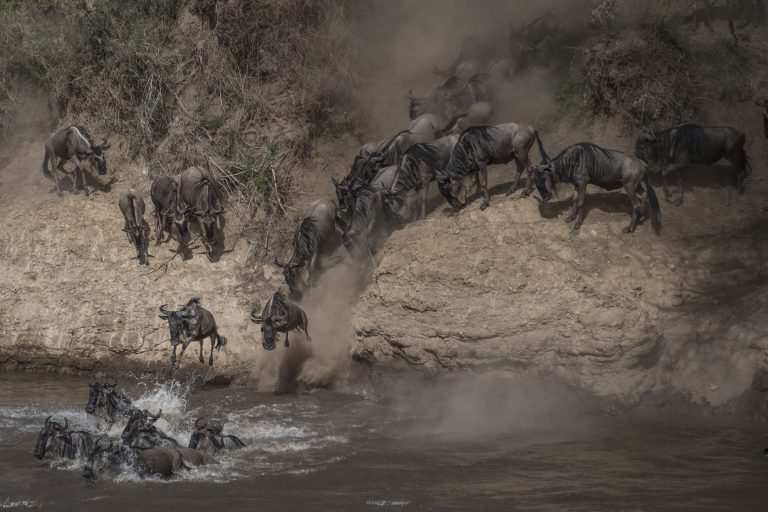 7-Day Masai Mara Migration SafariRiver crossings season, by road7 days · from $4,900 ppView trip →
Every trip is private and can be changed to suit you. Get a free, tailor-made quote in 6 hours →
Threats to the Masai Mara today
Fencing, land subdivision, farming and crowding at river crossings are the main pressures.
Fences, farming and subdivision
A 2017 peer-reviewed study of satellite images from 1985 to 2016 covered 668,500 ha of the Greater Mara. Fencing grew slowly until 2014, then spread quickly into open savannah. In the most-fenced conservancies, fenced area rose by more than 20 percent since 2010, and by 2016 fences covered almost all of southern Lemek. The authors warn of ecosystem collapse in the near future. They name subdivision of group ranches, wheat and maize farming and livestock growth as drivers. The study ends in 2016, and we found no newer assessment.
Livestock and wildlife numbers
The same study says livestock rose from 2 percent of total livestock and wildlife biomass inside the reserve in the 1970s to 23 percent in the 2000s. Resident wildlife in the Mara fell by more than 70 percent between the 1980s and 2000s, yet the Greater Mara still supports about 1.3 million wildebeest and 200,000 zebras. Wikipedia reports monitoring from 1989 to 2003 in which giraffe fell 75 percent, warthog 80 percent, hartebeest 76 percent and impala 67 percent, with poaching and grazing cited as causes.
More lodges and crowded crossings
Wikipedia puts the number of lodges at fewer than 10 in the late 1970s, 140 in 2008 and nearly 200 in 2016. An August 2025 news report quoted a tourism warden and a wildlife guide describing dozens of vehicles gathering when wildebeest cross the Mara River. The advocacy group Cheetah Guardians called it chaos without management. The report gave no official visitor or vehicle totals, and it mixes Kenyan and Tanzanian sources, so treat it as a picture of the wider Mara, not a measurement.
Governance and climate
Wikipedia describes rising tension between Maasai pastoralists and tourism operators, cattle entering areas where grazing was prohibited, and distrust of conservancy management companies, with original owners reportedly excluded from decisions and a fair share of profits. Climate adds uncertainty: swings in rainfall and drought affect pasture and the migration. We give no climate figures because we have no source for them.
Masai Mara conservation: what is being done
- The Mara Conservancy reports poacher arrests, snare removal, dog vaccination and community scouts in the Triangle, as described above.
- Conservancies cap beds and vehicles at sightings, and pay Maasai landowners leases or a share of profits. Mara Siana pays yearly leases to over 2,000 landowner families.
- The MMWCA gives conservancies a collective voice, and a founding member warns that if surrounding land were fenced, ploughed or built up, the reserve would be in serious trouble because it is too small to support wildlife alone.
Whether this is enough is open. The drivers the fencing study names, subdivision, farming and livestock growth, are all about land use around the reserve.
Get your free safari quote in 6 hours
Tell us your dates and who is travelling. A planner in our Nairobi office replies within 6 hours with a day-by-day itinerary, the camps we suggest and a fully itemised price. No payment is needed to enquire.
Prefer to talk? WhatsApp or call +254 799 871 255.
Frequently asked questions
When was the Masai Mara established?
It was set up as a 520 km² wildlife sanctuary in 1961 and made a game reserve the same year after an extension east. Part gained national reserve status in 1974. Sources differ slightly on some years, so treat them as close rather than exact.
How big is the Masai Mara today?
About 1,510 km² (580 sq mi), of which the Mara Triangle is 510 km². The conservancies lie next to the reserve. The Greater Mara depends on the definition: the fencing study used 668,500 ha, about 6,685 km².
Who manages the Masai Mara?
The reserve has been under Narok County management since 1961, first the county council and now the county government. The not-for-profit Mara Conservancy runs the Triangle under an agreement with the county. Conservancies run on leases between Maasai landowners and camp operators.
What is the difference between the Mara Triangle and the conservancies?
The Triangle is part of the national reserve, while conservancies are Maasai-owned land beside it with limits on beds and vehicles. Walking safaris are allowed in conservancies, not in the national reserve. Our Mara Triangle versus Greater Mara guide compares them.
How many conservancies are there?
It depends on who is counting. The MMWCA list has 22 conservancies or conservation areas, some outside the core Mara, and Wikipedia names 14. More than a dozen, and around 20 on the broadest lists, is a fair way to put it.
Is the Masai Mara still under threat?
Yes. Fencing, subdivision, farming and crowding at river crossings are the pressures named in the sources. The most recent fencing assessment we found covers images to 2016, so the current picture may differ. Our Masai Mara safari guide covers planning the trip itself.
Photo: Dawn in the Masai Mara by Make it Kenya, Public domain, via Wikimedia Commons


Comments are closed