

 Destinations, Experiences & East Africa Travel
Ol Pejeta Conservancy is a not-for-profit wildlife reserve of about 90,000 acres (about 360 km2) in Laikipia, west of Nanyuki and on the equator. By Ol Pejeta’s own figures it is about 220 km from Nairobi, roughly 4 to 4.5 hours by road. It is home to the last two northern white rhinos, the largest black rhino sanctuary in East Africa and Sweetwaters, which Ol Pejeta calls the only place in Kenya to see chimpanzees.
This guide covers the rhinos and chimpanzees, what you can do there, the daily entry fees, where to stay, when to go and how to fit Ol Pejeta into a longer Kenya safari.
Planning this trip? Get a free quote in 6 hours →
Ol Pejeta at a glance
| Fact | Detail |
|---|---|
| Location | Laikipia County, west of Nanyuki, between the Aberdare foothills and Mount Kenya, on the equator |
| Size | About 90,000 acres (about 360 km2) |
| From Nairobi | About 220 km, roughly 4 to 4.5 hours by road (Ol Pejeta’s figure) |
| From Nanyuki | A short drive; route planners estimate under 20 minutes to the conservancy, depending on the gate |
| Known for | The last two northern white rhinos, East Africa’s largest black rhino sanctuary, Sweetwaters chimpanzees, all of the Big Five |
| Daily entry, non-resident adult | USD 110 (child USD 55) |
| Included in entry | Chimpanzee viewing and game drives during gate hours |
| Gates | Rongai and Serat, 7 am to 7 pm |
| Good for | Close rhino encounters, a conservation-led safari and easy access from Nairobi |
What Ol Pejeta is and how it began
Ol Pejeta combines wildlife conservation, tourism, cattle ranching and community development, and it reinvests its commercial income in conservation. The ranching is real: a herd of more than 6,000 pure Boran cattle grazes alongside the wildlife, and the beef helps pay for the conservancy. Its history explains why it looks the way it does.
- 1940s: the land is bought by Lord Delamere and run as a cattle ranch under several owners.
- 1988: Lonrho Africa sets up Sweetwaters Game Reserve beside the ranch.
- Early 1990s: the Sweetwaters chimpanzee sanctuary opens (Ol Pejeta’s timeline says 1992, Wikipedia says 1993).
- 2003 to 2004: Fauna & Flora International and partners acquire the land, helped by a USD 15 million gift from the Arcus Foundation. Ol Pejeta’s own pages give both years.
- 2009: four northern white rhinos arrive from the Czech Republic.
- 2014: Ol Pejeta gains IUCN Green List status, which it describes as one of only five conservancies in Africa at the time.
Wildlife you can see
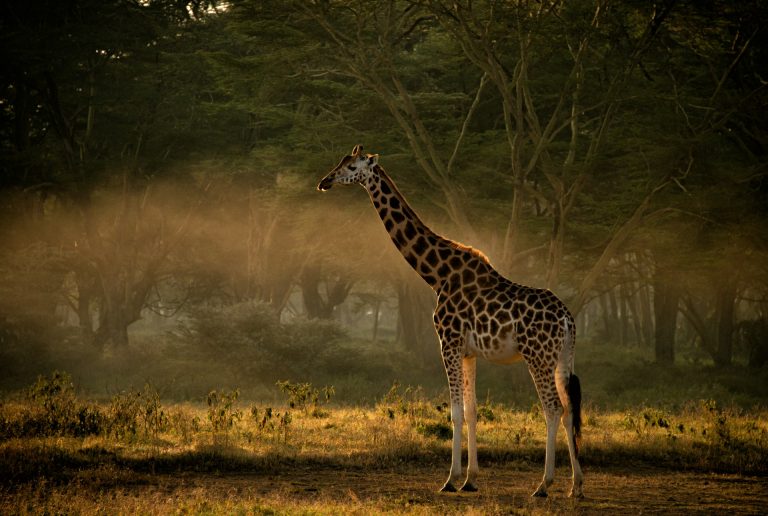
All of the Big Five live at Ol Pejeta: lion, elephant, buffalo, leopard and rhino. Leopard is the hardest of the five to find. Ol Pejeta says it has some of the highest densities of wildlife in Kenya outside the Maasai Mara, and more than 300 bird species have been recorded. Giraffe, hippo, hyena, jackal and several antelope species are regular sightings, and Grevy’s zebra, oryx and hartebeest are among the rarer animals the conservancy protects.
How to get to Ol Pejeta from Nairobi
By road
Ol Pejeta puts the distance at about 220 km and the drive at roughly 4 to 4.5 hours, depending on traffic and road conditions. Nairobi to Nanyuki alone is about 190 km, or 3 to 3.5 hours once Nairobi traffic is counted. The rest is the run from Nanyuki to the gate and on to your camp. The route leaves Nairobi on the Thika Superhighway, then passes through Thika, Makuyu, Karatina, Nyeri and Naro Moru before reaching Nanyuki. In the dry season a 2WD vehicle can reach the conservancy, but Ol Pejeta strongly recommends a 4×4 in the rains.
By air
Light aircraft serve Laikipia, and Nanyuki has an airstrip from which your camp can collect you. Schedules change, so we confirm flight times and transfers when we quote. Many travellers add Ol Pejeta to a longer route. Our 8 Days Ol Pejeta, Masai Mara and Amboseli luxury Kenya safari is one example, from USD 10,270 per person. Prices depend on season, group size and lodge choice.
The rhinos of Ol Pejeta
The black rhino sanctuary
Ol Pejeta describes itself as the largest black rhino sanctuary in East Africa, with well over 150 critically endangered black rhinos, and southern white rhinos live here too. The population has grown so well that in 2025 the government moved 21 black rhinos to Segera Rhino Sanctuary, also in Laikipia, to ease crowding at Ol Pejeta.
Older write-ups, including an earlier version of this page, say you can visit Baraka, the blind black rhino who was a favourite with visitors. Baraka died in August 2026, so treat any such mention as out of date.
The last two northern white rhinos
Only two northern white rhinos remain, both female: Najin, born in 1989, and her daughter Fatu, born in 2000. Both were born at Dvur Kralove Zoo in the Czech Republic, and four northern white rhinos were flown from there to Ol Pejeta in December 2009. Sudan, the last male, was euthanised on 19 March 2018 after a recurring infection. Neither female can breed naturally, and armed rangers guard them around the clock.
The hope now rests on assisted reproduction. In an update dated 22 April 2026, Ol Pejeta said the BioRescue consortium now holds 39 pure northern white rhino embryos, including one new embryo from an egg collection from Fatu at the start of 2026. Three embryo transfers into southern white surrogates in the second half of 2025 did not lead to a lasting pregnancy, and no pregnancy had been announced at that date. The team notes that human IVF took more than 100 attempts.
Ol Pejeta lists “Meet the Last Two Northern White Rhinos” among its experiences and says the booking supports rhino conservation. The page shows no price, so ask when you book. For the full story and how to arrange the visit, read our guide to seeing Najin and Fatu at Ol Pejeta.
Sweetwaters Chimpanzee Sanctuary
Sweetwaters opened in the early 1990s under an agreement between Ol Pejeta, the Kenya Wildlife Service and the Jane Goodall Institute. It shelters chimpanzees rescued from the illegal wildlife trade, and Wikipedia counts about 43 of them, though the figure is undated. They are rescued animals, not wild Kenyan chimpanzees, which is why Ol Pejeta can call it the only place in Kenya to see them.
Chimpanzee viewing is included in the daily entry fee, in two windows: 8:30 am to 12:30 pm and 2:00 pm to 4:30 pm. A separate “Behind the Scenes with the Chimpanzees” experience is also listed. Our guide to the Sweetwaters Chimpanzee Sanctuary covers the visit in more detail.
Things to do at Ol Pejeta
Ol Pejeta’s experiences page lists the activities below. It shows no prices or times, so confirm them when you book.
- All-day game drive: included in the entry fee between 7:00 am and 7:00 pm. If you do not bring a vehicle, a driver-guide vehicle costs KES 28,000 for a half day or KES 35,000 for a full day, according to Ol Pejeta’s FAQ.
- Night game drive: two slots, 7 to 9 pm and 9 to 11 pm, booked at least a day ahead.
- Lion tracking and dog tracking: guided outings listed as separate experiences.
- Guided bush or bird walk: a way to see Ol Pejeta’s birdlife on foot.
- Rhino monitoring and identification: time with the people who keep track of the rhinos.
- Run with Rangers: a route of 5 to 7 km.
- Conservation talks, livestock-wildlife integration and a virtual classroom: useful for families and curious travellers.
Horse riding and camel rides are not on Ol Pejeta’s list, so do not plan around them. The conservancy sits on the equator, so you may cross the line during your stay; ask your driver-guide where it is marked.
Ol Pejeta entry fees
These are the daily fees on Ol Pejeta’s official entry page. Fees last verified: October 2026. The page shows no effective date, so confirm the current tariff before you travel. We do this when we quote.
| Visitor | Adult | Child (3 to 11) | Student |
|---|---|---|---|
| Non-resident | USD 110 | USD 55 | USD 32 |
| East African resident | KES 3,500 | KES 1,750 | KES 500 |
| East African citizen | KES 2,000 | KES 1,000 | KES 500 |
Children under 3 are free. Vehicles pay separately: KES 1,000 for up to 6 seats, KES 5,000 for 7 to 14 seats and KES 12,000 for 15 or more seats. The fee covers one visit, so a guest who leaves and re-enters pays again. Gates are cashless, so arrange payment before you arrive.
Put Ol Pejeta into a Kenya safari
- 8 Days Ol Pejeta Masai Mara Amboseli Luxury Kenya Safari: for travellers who want a luxury route linking Ol Pejeta, the Masai Mara and Amboseli. From USD 10,270 per person.
- 10-Day Kenya Safari: Samburu to the Maasai Mara: for travellers who want northern Kenya and the Mara in one trip; ask us whether Ol Pejeta can be worked in. From USD 5,100 per person.
Prices depend on season, group size and lodge choice.
Safaris that fit this guide
 9-Day Hidden Northern Kenya SafariLaikipia, Meru and Samburu off the beaten track9 days · from $4,730 ppView trip →
 7-Day Untamed Skies: Northern Kenya by AirSamburu, Meru and Ol Pejeta by light aircraft7 days · from $3,840 ppView trip →
 10-Day Samburu to Masai Mara SafariSamburu, Ol Pejeta, Nakuru and the Mara10 days · from $5,100 ppView trip →
Every trip is private and can be changed to suit you. Get a free, tailor-made quote in 6 hours →
Where to stay at Ol Pejeta
Ol Pejeta’s tourism partners page lists eight lodgings. We give no nightly prices here because the properties set their own and the conservancy fee is often charged separately; we itemise both in a quote.
| Property | What it is |
|---|---|
| Sanctuary Tambarare | Luxury tented camp with 10 guest tents |
| Ol Pejeta Safari Cottages | Four private, fully staffed cottages built in 2017, each with its own driver-guide and vehicle |
| Kicheche Laikipia Camp | Six tents in the wilderness zone, with a waterhole and Mount Kenya behind |
| Sweetwaters Serena Camp | Large tented camp with ensuite bathrooms, Mount Kenya views, a pool and a spa treatment room |
| Porini Rhino Camp | Simple, well-established camp with eight guest tents and a wildlife viewing hide |
| Ol Pejeta Bush Camp | Simple camp with comfortable tents |
| Mutara Camp | Cliff-top camp, the only accommodation in the 20,000-acre Mutara Conservancy next door |
| River Camp | Listed by Ol Pejeta without further detail |
Two more options suit self-catering travellers. Pelican House and The Stables do not provide game-drive vehicles. Ol Pejeta quotes The Stables at USD 70 single and USD 140 double per night, full board, with USD 35 for a child sharing; the conservancy fee is extra and paid at the main gate. Public campsites include Ewaso, Hippo Hide, Mbogo, Murera Donga, Ol Lerai and Scott’s Hide, and an armed ranger is mandatory at KES 5,000 per ranger per night.
Best time to visit Ol Pejeta
Ol Pejeta’s wildlife lives there all year, so there is no migration to time. The practical difference is the weather. The roads are easiest in the dry season, and a 4×4 matters most in the rains. On the Laikipia plateau, as at neighbouring Lewa, days are usually hot and dry and nights are cool.
Ol Pejeta publishes no season calendar on the pages we checked. As a guide, the season dates below come from Elewana Lewa Safari Camp, a camp on Lewa Wildlife Conservancy, and show how rates move through the year.
| Season at Elewana Lewa Safari Camp | Dates |
|---|---|
| High | 1 July to 31 October and 20 December to 3 January |
| Mid | 4 January to 31 March, 1 to 30 June and 1 November to 19 December |
| Green | 1 April to 31 May, the camp’s low season, named for the rains |
If you want the easiest roads and the busiest camps, aim for the high season and book early. If you prefer fewer vehicles and lower rates and accept a wetter landscape, look at the Green and mid seasons.
Combining Ol Pejeta with other parks
Ol Pejeta works well as the first or last stop on a northern route. Our guide to a northern Kenya safari with Samburu, Ol Pejeta and Laikipia shows how it fits into 7 to 9 days. Some travellers fly on to the Mara afterwards. If you are choosing between Laikipia conservancies, see Ol Pejeta vs Lewa. Our 10-day Samburu to Maasai Mara safari shows a northern-and-Mara route in practice. These distances from Nanyuki are route-planner estimates, not official figures.
| From Nanyuki to | Distance and time |
|---|---|
| Lewa Wildlife Conservancy | About 51 km, about 1 hour 25 minutes by road |
| Samburu National Reserve | About 118 km, about 2 hours 20 minutes by road; a 30 to 40 minute flight |
| Lake Nakuru National Park | About 160 km, about 3 hours 40 minutes by road |
| Masai Mara | About 375 km, over 7 hours by road; about 1 hour 15 minutes by air |
Practical tips for your visit
- Bring layers. On the Laikipia plateau, nights are cool even when the day is hot.
- Pack binoculars. They help with birds and with animals that stay at a distance.
- Book activities ahead. Night drives need at least a day’s notice, and the northern white rhino meeting is a booked experience.
- Allow a full day. The entry fee covers one visit, and chimpanzee windows and the game drive run on set hours.
- Follow your ranger. On walks and other foot activities, stay with your guide and listen to the briefing.
Get your free safari quote in 6 hours
Tell us your dates and who is travelling. A planner in our Nairobi office replies within 6 hours with a day-by-day itinerary, the camps we suggest and a fully itemised price. No payment is needed to enquire.
Prefer to talk? WhatsApp or call +254 799 871 255.
Frequently asked questions
How much is the Ol Pejeta entry fee?
A non-resident adult pays USD 110 a day, a child aged 3 to 11 pays USD 55 and a student pays USD 32. Children under 3 are free. East African residents and citizens pay lower rates in Kenyan shillings. Fees last verified: October 2026, and Ol Pejeta’s page shows no effective date, so confirm before travelling.
How far is Ol Pejeta from Nairobi?
Ol Pejeta gives about 220 km and roughly 4 to 4.5 hours by road. Nairobi to Nanyuki is about 190 km, or 3 to 3.5 hours, and the conservancy lies a short drive beyond.
Can I see the last two northern white rhinos?
Yes. Najin and Fatu live at Ol Pejeta under 24-hour armed guard, and the conservancy lists a “Meet the Last Two Northern White Rhinos” experience. It shows no price on its page, so ask when you book.
Are the Sweetwaters chimpanzees wild?
No. They are chimpanzees rescued from the illegal wildlife trade and cared for in the sanctuary. Viewing is included in the daily entry fee, 8:30 am to 12:30 pm and 2:00 pm to 4:30 pm.
Do I need a 4×4 to reach Ol Pejeta?
In the dry season a 2WD vehicle can reach the conservancy. Ol Pejeta strongly recommends a 4×4 in the rains, and on a guided safari your operator arranges the vehicle.
How long should I spend at Ol Pejeta?
One full day covers a game drive and the chimpanzees. Two nights let you add a night drive, lion tracking or a rhino experience without rushing.
Comments are closed