
 Safari, Wildlife & Conservation
Only two northern white rhinos are left in the world: Najin and her daughter Fatu, both female, who live under 24-hour armed security at Ol Pejeta Conservancy in Laikipia, Kenya. Ol Pejeta lists a “Meet the Last Two Northern White Rhinos” experience, and the conservancy is about 220 km from Nairobi, a drive of roughly 4 to 4.5 hours. This guide covers how the northern white rhino got here, where the rescue programme stands and what a visit involves.
Ol Pejeta is one of the reserves on the plateau we cover in our guide to the Laikipia conservancies, west of Nanyuki and on the equator. The figures below come from Ol Pejeta’s own pages, the Kenya Wildlife Service (KWS) and other published sources.
Planning this trip? Get a free quote in 6 hours →
At a glance: the northern white rhino
| Question | Answer |
|---|---|
| How many are left | Two, both female: Najin (born 1989) and her daughter Fatu (born 2000) |
| Where they live | Ol Pejeta Conservancy, Laikipia County, Kenya |
| Conservation status | Critically Endangered, possibly extinct in the wild (IUCN); called “functionally extinct” by the KWS |
| The last male | Sudan, euthanised on 19 March 2018 after a recurring infection |
| Embryos | 39 pure northern white rhino embryos, per Ol Pejeta’s update of 22 April 2026 |
| Getting there | About 220 km from Nairobi, roughly 4 to 4.5 hours by road |
| Daily entry | USD 110 per non-resident adult, USD 55 per child aged 3 to 11. Fees last verified: October 2026. |
| A trip that includes Ol Pejeta | 8 Days Ol Pejeta Masai Mara Amboseli Luxury Kenya Safari, from USD 10,270 per person (prices depend on season, group size and lodge choice) |
How the northern white rhino came down to two
By 2009 only seven northern white rhinos were left in captivity, and four of them were flown from Dvur Kralove Zoo in the Czech Republic to Ol Pejeta. Najin and Fatu, both born at that zoo, are the survivors. Tests in 2015 showed that neither can breed naturally, which is why the KWS calls the species “functionally extinct”.
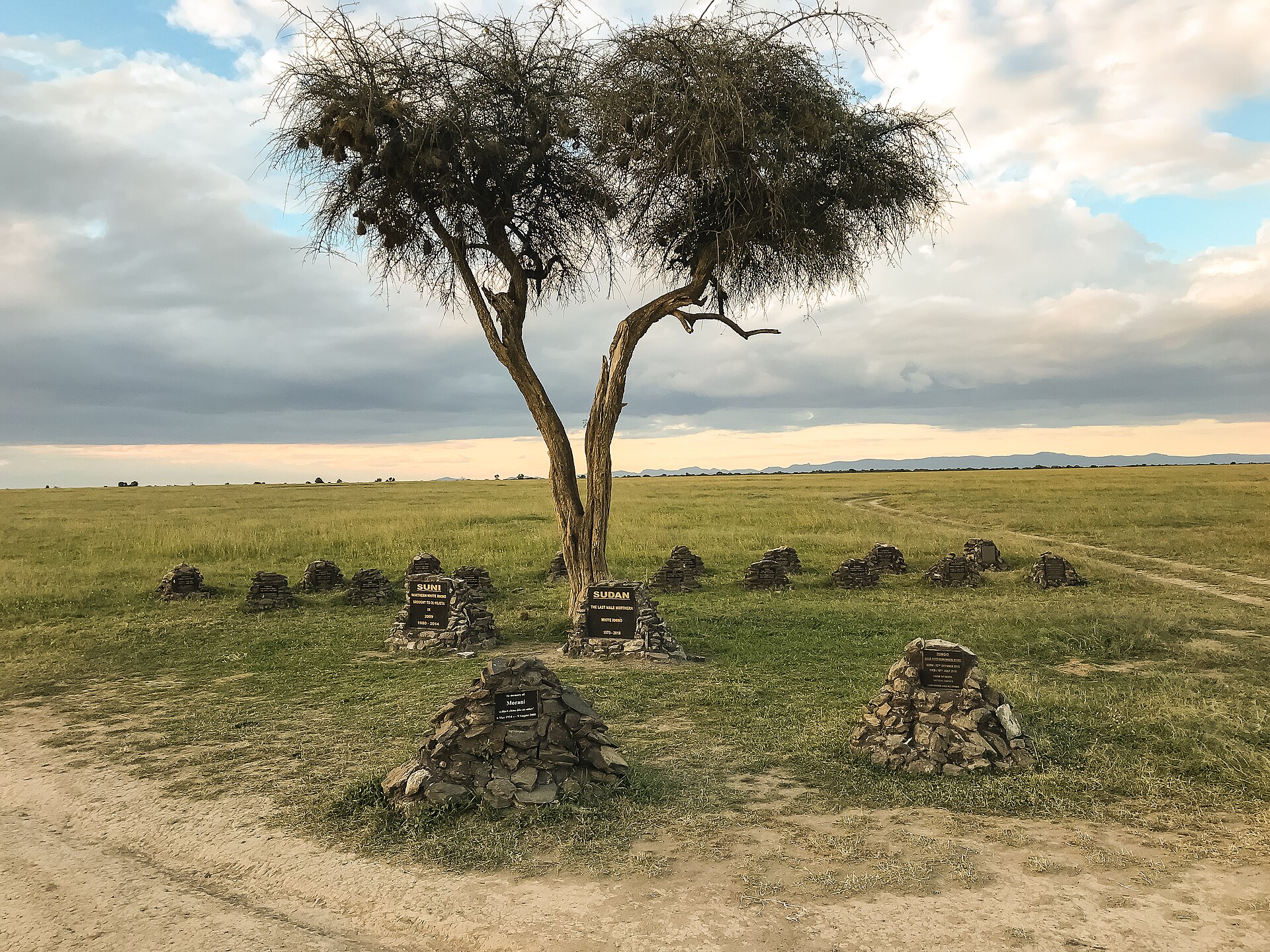
Sudan, the last male, was caught in the wild in 1975. He was euthanised on 19 March 2018 after a recurring infection. His death left no male to breed with Najin and Fatu, and the species’ future now depends on the laboratory effort described below.
| Date | What happened |
|---|---|
| 20 December 2009 | Four northern white rhinos are flown from Dvur Kralove to Ol Pejeta |
| October 2014 | Suni, another male, dies of natural causes |
| 19 March 2018 | Sudan is euthanised |
| 24 September 2023 | First rhino embryo transfer at Ol Pejeta, a southern white embryo in a southern white surrogate called Curra |
| Second half of 2025 | Three northern white embryo transfers do not lead to a long-term pregnancy |
| 22 April 2026 | Ol Pejeta reports 39 pure northern white embryos |
Visiting Najin and Fatu at Ol Pejeta
What a visit involves
Ol Pejeta’s experiences page lists “Meet the Last Two Northern White Rhinos” as a named activity and says every penny of that booking supports rhino conservation. The page shows no price and no time, so ask for both when you book and request the visit in advance rather than on the day. For the wider picture, see our complete guide to Ol Pejeta Conservancy.
Entry fees
| Visitor | Daily entry |
|---|---|
| Non-resident adult | USD 110 |
| Non-resident child, 3 to 11 years | USD 55 (under 3 free) |
| Non-resident student | USD 32 |
| East African resident adult | KES 3,500 |
| Vehicle up to 6 seats | KES 1,000 |
Fees last verified: October 2026. Ol Pejeta’s tariff page shows no effective date, so confirm the current rate when you book. The daily fee includes meeting the chimpanzees at Sweetwaters (8:30 am to 12:30 pm and 2:00 pm to 4:30 pm) and an all-day game drive (7:00 am to 7:00 pm); if you leave and come back in, you pay again. Ol Pejeta also hires out a driver-guide vehicle at KES 28,000 for a half day or KES 35,000 for a full day.
Getting there
Ol Pejeta puts itself about 220 km from Nairobi, a drive of roughly 4 to 4.5 hours depending on traffic and road conditions. A 2WD vehicle can reach it in the dry season, but a 4×4 is strongly recommended in the rains. A same-day return from Nairobi means roughly 8 to 9 hours on the road, so one night in or near the conservancy is more comfortable.
Where to stay and what else to do
Ol Pejeta’s tourism-partners page lists eight places to stay, including Sweetwaters Serena Camp (tented, with Mount Kenya views and a pool), Porini Rhino Camp (eight guest tents), Sanctuary Tambarare (10 tents) and Kicheche Laikipia Camp (six tents). Rates differ by camp and season, so ask for a quote. Beyond the rhinos:
- Chimpanzees: Sweetwaters shelters rescued chimpanzees, and Ol Pejeta calls it the only place in Kenya to see them.
- Black rhinos: well over 150 live here, in what Ol Pejeta describes as East Africa’s largest black rhino sanctuary.
- Night game drives: 7 to 9 pm and 9 to 11 pm, booked at least a day ahead.
Build a safari around the rhinos
8 Days Ol Pejeta Masai Mara Amboseli Luxury Kenya Safari: for travellers who want a luxury route pairing Ol Pejeta with the Masai Mara and Amboseli. From USD 10,270 per person.
10-Day Kenya Safari: Samburu to the Maasai Mara: for travellers who want a longer Kenya circuit ending in the Mara. Ask whether a stop at Ol Pejeta can be added. From USD 5,100 per person.
Prices depend on season, group size and lodge choice.
Where the rescue effort stands
The main hope for the species is BioRescue, a consortium led by Leibniz-IZW with Ol Pejeta, Safari Park Dvur Kralove, the KWS and other partners. It creates northern white embryos in the laboratory and transfers them into southern white surrogate mothers at Ol Pejeta. Ol Pejeta’s update of 22 April 2026 reported:
- 39 pure northern white rhino embryos now exist, including one new embryo from an egg collection from Fatu at the start of 2026.
- Three northern white embryo transfers at Ol Pejeta in the second half of 2025 did not lead to a long-term pregnancy. The consortium has made six embryo transfers in total.
- Two new proven southern white surrogates have joined, and the team hopes for a pregnancy in the foreseeable future. It notes that human IVF took more than 100 attempts.
The method has one proven step. After the September 2023 transfer, Curra carried a southern white pregnancy for 70 days, with a male foetus of 6.4 cm, before she died of a bacterial infection after flooding in November 2023.
No pregnancy had been announced as of the 22 April 2026 update, and a search on 25 October 2026 found no newer BioRescue or Ol Pejeta news. Nobody can yet say whether a northern white calf will be born, so treat any claim that the species is “saved” with caution.
Northern white, southern white and black rhinos: what is the difference?
Kenya had 2,102 rhinos at the end of 2024, up from 384 in 1987, according to the KWS. They fall into three groups.
| Rhino | IUCN status | Kenya, end of 2024 (KWS) |
|---|---|---|
| Northern white | Critically Endangered, possibly extinct in the wild | 2 |
| Southern white | Near Threatened (white rhino as a whole) | 1,041 |
| Eastern black | Critically Endangered (black rhino) | 1,059 |
The northern and southern white rhinos are two subspecies of the white rhino. IUCN figures reported by Save the Rhino put all white rhinos at 15,752, mostly in South Africa, against 6,788 black rhinos across Africa. In the field the quickest tell is the mouth: white rhinos graze with a wide, flat lip, while black rhinos browse leaves with a pointed, hooked upper lip. To see why so many of Kenya’s rhinos live on one plateau, read our piece on rhino conservation in Laikipia.
Who the visit suits and what to bring
The visit suits conservation-minded travellers, families (children under 3 enter free; ages 3 to 11 pay USD 55) and anyone adding Laikipia to the Masai Mara, which our Masai Mara safari guide covers. Bring binoculars, a camera with a zoom lens, layers for early starts, a hat and sun cream. The main seasonal factor is the road, so tell your planner your dates and they can plan around the rains.
Get your free safari quote in 6 hours
Tell us your dates and who is travelling. A planner in our Nairobi office replies within 6 hours with a day-by-day itinerary, the camps we suggest and a fully itemised price. No payment is needed to enquire.
Prefer to talk? WhatsApp or call +254 799 871 255.
Frequently asked questions
How many northern white rhinos are left?
Two: Najin, born in 1989, and her daughter Fatu, born in 2000. Both are female, both were born at Dvur Kralove Zoo in the Czech Republic, and both live at Ol Pejeta.
Can you visit the last northern white rhinos?
Yes. Ol Pejeta lists “Meet the Last Two Northern White Rhinos” as an experience. The page shows no price or time, so ask when you book. The daily conservancy fee is USD 110 for a non-resident adult (fees last verified: October 2026).
What happened to Sudan, the last male?
Sudan was caught in the wild in 1975 and was euthanised on 19 March 2018 after a recurring infection. Another male, Suni, had died of natural causes in October 2014.
Can the northern white rhino be saved?
Possibly, but nobody can promise it. BioRescue holds 39 pure embryos as of 22 April 2026, yet the 2025 transfers did not lead to a long-term pregnancy and none had been announced at that date.
How far is Ol Pejeta from Nairobi?
About 220 km, roughly 4 to 4.5 hours by road depending on traffic and conditions. A 4×4 is strongly recommended in the rains.
Is a white rhino really white?
No. Both white and black rhinos are grey. The practical difference is the mouth: a wide, flat lip for grazing on white rhinos and a pointed, hooked upper lip for browsing on black rhinos.
Photo: Ol Pejeta Rhino Cemetery & Memorial, Remembering Sudan (the last male northern white rhino) One Year On (46723597264) by Ray in Manila, CC BY 2.0, via Wikimedia Commons


Comments are closed