
 Safari Planning, Travel Guides & Practical Advice
Is Masai Mara worth it for a first safari? For most first-time visitors, yes, provided you choose your months with care and are comfortable with a daily park fee that doubles in July. The Maasai Mara National Reserve covers 1,510 km² (about 580 square miles) of Narok County in south-western Kenya and borders Tanzania’s Serengeti, which is why the wildebeest herds arrive here, usually from July to October. This honest Masai Mara review covers what you gain, what you pay and who should look elsewhere, and it works alongside our full Masai Mara safari guide.
The case for going is strong: open grassland, big cats and, in season, the world’s largest migrating herd of hoofed animals. The case against is just as real: a park fee that rises sharply in the second half of the year, vehicles bunching at river crossings, bumpy tracks and a migration that keeps its own calendar. If you only have a few days, our 3-day Maasai Mara safari starts from USD 1,420 per person; prices depend on season, group size and lodge choice.
Planning this trip? Get a free quote in 6 hours →
Masai Mara at a glance
| Fact | Detail |
|---|---|
| Where | Narok County, south-western Kenya, next to Tanzania’s Serengeti |
| Size of the reserve | 1,510 km² (about 580 sq mi) |
| Altitude | About 1,500 to 2,200 m, so mornings can be cool |
| Herds usually in the Mara | About July to October, with the busiest river-crossing action from late July to September |
| Park fee, non-resident adult | USD 100 per day from 1 January to 30 June; USD 200 per day from 1 July to 31 December |
| Ticket hours | A 12-hour ticket, valid 6:00 am to 6:00 pm |
| Getting there from Nairobi | By road, or by air to a Mara airstrip |
Fees last verified: October 2026.
What you get: the case for going
Big cats on open plains
Lions, leopards and cheetahs are what most first-timers hope for, and open grassland generally makes them easier to find than thick bush does. No one can promise a particular sighting. The Mara Predator Conservation Programme works across a study area of more than 3,000 km² that takes in the reserve, the Mara Triangle and 16 conservancies or conservation areas. That is a research definition, not an administrative boundary, but it shows how much land the wildlife uses beyond the reserve itself.
The migration
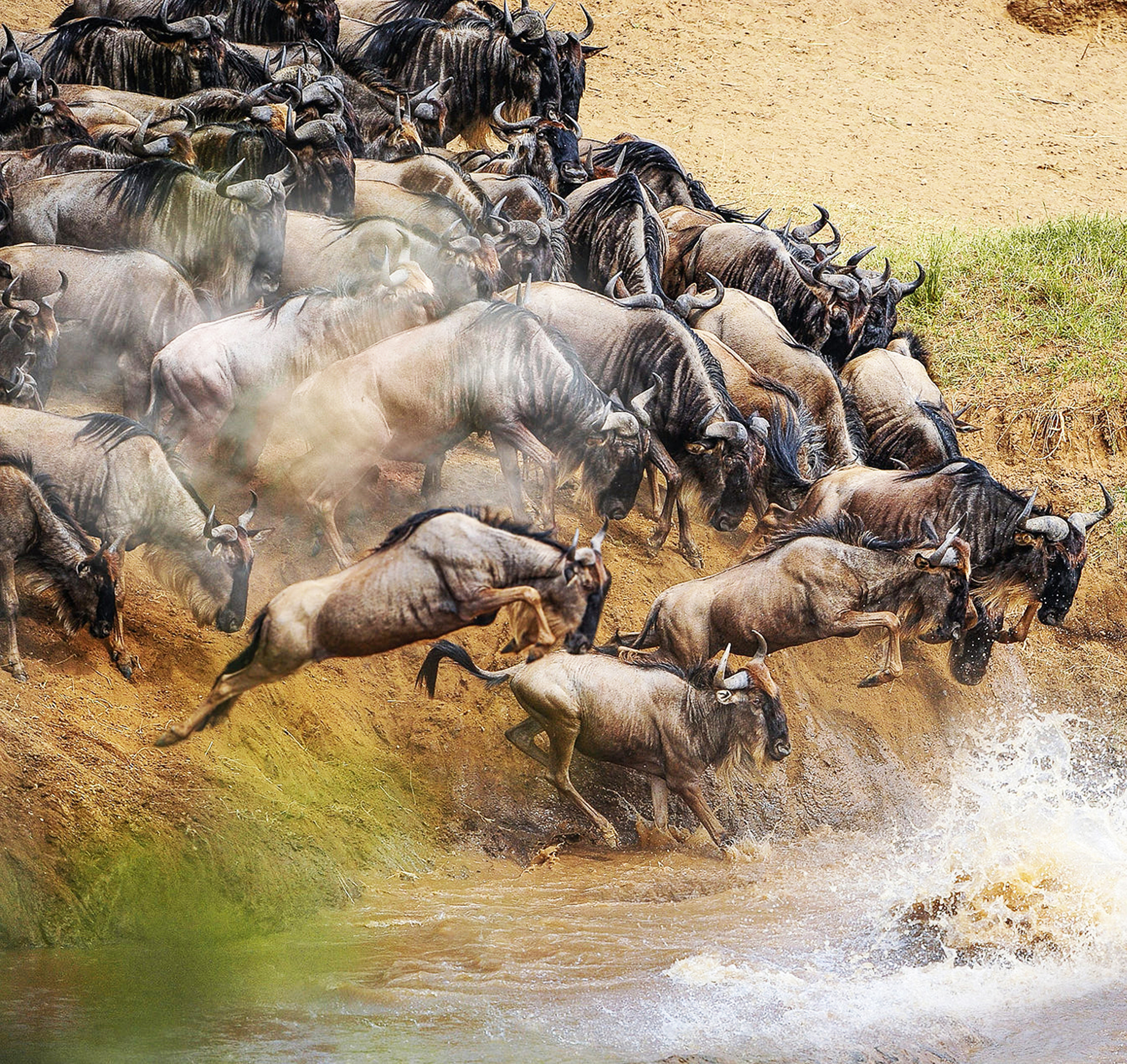
The Great Migration is one population that circulates between the southern Serengeti in Tanzania and the Mara in Kenya. The Mara sees it for only part of the year, usually about July to October. Crocodiles wait in the Mara River, and zebras usually lead each crossing with wildebeest following. Counts disagree on the size of the herd: a 2023 aerial count by Tanzania’s wildlife research institute found about 1.37 million wildebeest, a 2025 satellite study fewer than 600,000. Estimates range from about 0.5 million to 1.4 million. If the herds are your priority, look at our 5-day Masai Mara migration safari, from USD 2,750 per person.
One reserve, two sides
Most of the reserve is the Narok sector, run by the Narok County Government. The Mara Triangle, about 510 km² in the south-west, west of the Mara River, is run on the county’s behalf by the not-for-profit Mara Conservancy and sells its own ticket. Which side your camp is on decides which gate you use and which ticket you buy.
Reaching it from Nairobi
You can drive or fly to an airstrip, which makes the Mara one of the easier famous safaris to fit into a Kenya trip. Travel time depends on the route and the road, so ask for the exact transfer before you book.
The honest downsides
The park fee
For non-resident adults the fee is USD 100 per day from 1 January to 30 June and USD 200 per day from 1 July to 31 December, as reported by Business Daily in May 2026. Children aged 9 to 17 pay USD 50, and younger children are free (confirm age 8 with your operator). Two adults in the reserve for one day pay USD 400 in park fees in August and USD 200 in March. A fee is charged for each day you are inside, on a ticket valid 6:00 am to 6:00 pm. If you leave by road on your departure morning, be out by about mid-morning (sources say 10 am or 11 am) or you may pay for another day. For the Mara Triangle, check current amounts with the Mara Conservancy. Fees last verified: October 2026.
Crowds at the river crossings
In peak weeks, several vehicles can gather at the better-known crossing points, and a crossing can stall for hours while the herd decides. One operator guide describes Mawe Mawe as heavily used, while the nearby Pontoon crossing can be reached by only a handful of vehicles. Visitor numbers are well down on two years ago: Kenya’s Economic Survey 2026, as reported by Business Daily, gives 420,000 Mara visitors in 2023, 343,000 in 2024 and 213,000 in 2025, while Amboseli rose from 222,000 to 295,000. A quieter reserve does not guarantee an empty crossing.
Rough roads and long days
Many tracks inside the reserve are unsurfaced. They can be dusty and bumpy in dry months and slow after heavy rain, and flooding can change when herds cross the river. Game drives are long days in a vehicle.
The migration keeps its own calendar
Timing depends on rain and grass. In 2021 Kenyan scientists said the herds were delayed significantly after weak March to May rains. In wet years, arrivals can begin in mid-June. The calving season, January to March, takes place on the southern Serengeti plains in Tanzania, not in the Mara.
Best time to go, month by month
| Months | Where the herds usually are | Park fee, non-resident adult |
|---|---|---|
| January to March | Southern Serengeti, Tanzania, for calving; the Mara has resident wildlife only | USD 100 per day |
| April to May | Moving north through Tanzania; Kenya’s long rains fall in these months | USD 100 per day |
| June | Mostly still in Tanzania, with early arrivals possible from mid-June in wet years | USD 100 per day until 30 June |
| July to September | Usually in the Mara; crossings busiest from late July to September | USD 200 per day from 1 July |
| October | Usually still in the Mara, starting to head south | USD 200 per day |
| November to December | Heading south from early November, usually back in the south by December | USD 200 per day until 31 December |
If the herds are the point, aim for late July to September and plan well ahead. If value matters more, January to June costs half as much in park fees, but you give up the migration.
Compare two real Mara itineraries
- 5 days Masai Mara Migration Safari suits travellers who want the herds as the focus. From USD 2,750 per person.
- 10-Day Kenya Safari: Samburu to the Maasai Mara suits first-timers who want two different parks in one trip. From USD 5,100 per person.
Prices depend on season, group size and lodge choice.
Worth it if, skip it if
| Your situation | Worth it if | Look elsewhere if |
|---|---|---|
| Timing | You can travel from July to October and want the herds | You can only travel from January to March and want calving, which happens in Tanzania |
| Budget | You accept the daily park fee as part of the cost | You are travelling from July to December on a tight budget, when the fee is USD 200 per adult per day |
| Crowds | You do not mind sharing a sighting with other vehicles | You want solitude; read our guide to the Laikipia conservancies |
| Time | You can give it several days; see how many days you need in the Masai Mara | You have a single free day |
| Variety | The Mara is your main goal | You want more than one landscape; our 10-day trip pairs Samburu with the Mara |
| Comfort | You enjoy long game drives on bumpy tracks | You have back trouble; ask about flying in |
Practical details before you go
- Carry your passport. The Mara Conservancy does not accept driver’s licences as ID, and anyone without suitable ID pays the non-resident rate.
- Ask how tickets are paid. The Mara Triangle says it does not take cash, while the rule on the Narok side is less clear, so ask whoever books your safari.
- Pack layers. At 1,500 to 2,200 m, early drives can be cool. Bring neutral clothes, a hat, sunscreen, binoculars and a dust cover for your camera.
- Balloon flights. A Masai Mara hot-air balloon flight is an optional extra at USD 550 per person. Flying on your departure morning inside the Mara Triangle also needs a full-day park fee, according to Governors’ Camp.
- Cultural visit. A Maasai village visit is USD 30, paid on the day, on our 3-day trip, and it is included on the 10-day trip.
- First safari ever? Our first-time African safari guide covers what to expect.
Get your free safari quote in 6 hours
Tell us your dates and who is travelling. A planner in our Nairobi office replies within 6 hours with a day-by-day itinerary, the camps we suggest and a fully itemised price. No payment is needed to enquire.
Prefer to talk? WhatsApp or call +254 799 871 255.
Frequently asked questions
Is the Masai Mara worth it for a first-time safari?
For most first-timers, yes. The open plains, the big cats and the chance of the migration make it a strong first safari. It suits you less if you can only travel from January to March and want calving, or if the daily park fee will stretch your budget.
Should I visit Masai Mara in the low season or the high season?
From 1 January to 30 June the park fee is USD 100 per adult per day, but the herds are usually elsewhere. From 1 July to 31 December it is USD 200 and the herds usually arrive. Decide which matters more to you.
Do I pay the park fee for every day?
Yes. A fee is charged for each day you spend in the reserve, and the ticket covers 12 hours, from 6:00 am to 6:00 pm.
Will I see the Great Migration?
Only if you visit in the right months and the rains cooperate. The herds are usually in the Mara from about July to October, but arrival and departure shift from year to year, and crossings cannot be scheduled.
Is the Masai Mara crowded?
It can be at popular crossing points in peak weeks. Visitor numbers fell from 420,000 in 2023 to 213,000 in 2025, so it is quieter than two years ago, though not empty.
Is the Masai Mara better than Amboseli or Samburu?
Neither is better in every way. The Mara is the park for the migration, while Amboseli and Samburu offer different landscapes and wildlife. Our guide to Masai Mara vs Amboseli vs Samburu compares the three side by side.

Comments are closed