
 Destinations, Experiences & East Africa Travel
Ol Kinyei is one of the smaller private conservancies in the Masai Mara, about 18,500 acres (roughly 7,500 hectares) of rolling grassland between the national reserve and the Loita plains. It was founded in 2005, it holds only a handful of camps, and it is a good choice if you would rather share a lion sighting with one or two other vehicles than a dozen. It is one of the best-known members of Kenya’s wildlife conservancies.
The quiet comes from numbers, not from a lack of animals. Camps in Ol Kinyei are few and small, vehicles are limited, and the land is leased from Maasai landowners who are paid to keep it for wildlife. This guide explains where it is, what you can do there, when to go and how it compares with its bigger neighbours.
Planning this trip? Get a free quote in 6 hours →
Ol Kinyei at a glance
| Topic | What to know |
|---|---|
| Location | North-east of the Masai Mara National Reserve, between the reserve and the Loita migratory plains; it borders Naboisho Conservancy |
| Size | About 18,500 acres (about 7,500 hectares). The operator quotes 18,700 acres |
| Founded | 2005 |
| Camps | Two tented camps, both run by Gamewatchers Safaris under the Porini name: Porini Mara Camp and Porini Cheetah Camp |
| Camp size | Porini Mara Camp has six safari tents, one of them a family unit |
| Vehicle density | The operator states no more than one vehicle per 1,400 acres and one tent per 700 acres |
| Activities | Game drives, night drives, guided walks, off-road driving to follow animals, sundowners |
| Getting there | Usually a flight from Nairobi’s Wilson Airport to Ol Seki airstrip, then a short transfer |
| Who it suits | Travellers who want space, photography and walks; couples, families with older children, repeat visitors |
Figures for size come from the Mara Conservancies association (18,641 acres in its text) and the camp operator; they differ slightly, so treat them as “about 18,500 acres”.
Where Ol Kinyei sits in the Mara
The Mara’s conservancies form a belt of community land around the north and east of the national reserve. Ol Kinyei sits on the north-eastern side, between the reserve and the Loita plains where the wildebeest calve early in the year. Its neighbour to the south-west is Naboisho, and Camps in Ol Kinyei can arrange drives into Naboisho as well, which widens the area you cover.
The wider Mara has well over a dozen conservancies. The Mara Conservancies association lists 22 conservancies or conservation areas; other counts give 14 or 16, depending on what is included. Ol Kinyei is among the oldest of the group and, according to the camp operator, is one of only three sites in Kenya on the IUCN Green List of Protected and Conserved Areas.
For the bigger picture, see our guides to the Masai Mara National Reserve versus the conservancies and the complete Masai Mara safari guide.
Why it feels quiet
Three things keep Ol Kinyei calm.
- Few beds. The land supports two camps, and the operator limits itself to one tent for every 700 acres. For comparison, one guide describes the standard across conservancies as roughly one guest per 350 acres.
- Few vehicles. Only guests staying in a member camp may drive in a conservancy, and self-driving is not allowed. The operator states no more than one vehicle per 1,400 acres.
- A reason to protect the land. Maasai landowners receive a lease payment. Some conservancies also let cattle graze in agreed areas, so you may see herders and cattle in the distance.
Rules at a sighting are set by each conservancy. The only published limit we have read is from Mara North Conservancy, which allows no more than five vehicles at a sighting. Ask your camp what applies in Ol Kinyei on the day.
What you can do in Ol Kinyei
Conservancies allow things the national reserve does not. In the reserve you must stay on marked tracks, return by sunset and you cannot walk. In a conservancy, the picture changes.
Game drives and off-road driving
Guides can leave the track to follow a cheetah or position the vehicle for light, within the conservancy’s rules. This is a big gain for photographers, because you can set up a sighting without craning past six other roofs.
Night drives
Night drives are offered in the conservancies and not in the reserve. They run in designated areas with red-filtered lights and finish by about 10 pm. They are the best way to see animals you rarely meet by day, such as genets, bush babies, porcupines and hunting hyenas.
Guided walks
Walking safaris are led by an armed ranger. You learn tracks, dung, insects and plants, and you see the landscape at the pace of a person rather than an engine. Walks suit active guests; ask about age limits, which vary by camp.
Cultural visits
Camps can arrange a visit to a Maasai village. On our 3-day trip this costs USD 30 paid on the day, and it is included on our 10-day trip.
Wildlife you can expect
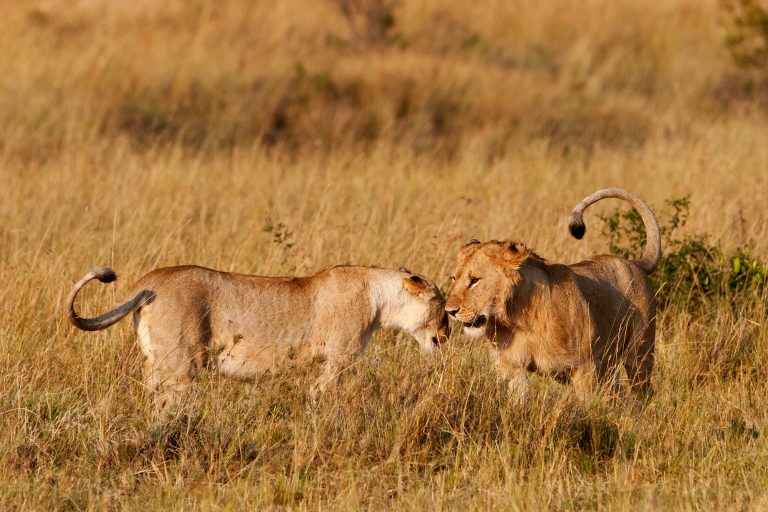
The camp operator lists resident lions, leopards, cheetahs, elephants, giraffes and Cape buffalo. Zebra, waterbuck and hyena are also common across this part of the Mara. The open plains and the long grass near streams suit big cats, and the lower numbers of vehicles mean you are more likely to stay with a sighting.
The operator also notes that the wildebeest of the Loita plains arrive as early as January and that calving is in February and March, after which the herds move on to Naboisho and Olare Motorogi. That early-year calving season brings predators close behind the herds. It is a different story from the July to October river crossings, which happen on the reserve’s Mara and Talek rivers rather than in Ol Kinyei.
Best time to visit
| Period | What to expect |
|---|---|
| January to March | Loita wildebeest herds nearby; calving in February and March, with predators following |
| June to October | Usually the drier months and the main season for the Great Migration across the wider Mara; conservancies stay quieter than the reserve but rates are higher |
| November to December | Short rains; greener, fewer visitors, good birding. Roads can be muddy |
| April to May | Long rains; the lowest rates and the fewest guests, with some camps closing for part of the period. Ask us what is open |
Because Ol Kinyei is a resident-wildlife area and not a river-crossing site, it works across the year. If the migration is your priority, combine it with time in the reserve; our 7 Days Maasai Mara Migration Safari is built around that, from USD 4,900 per person.
How to get there
Most guests fly from Nairobi’s Wilson Airport to Ol Seki airstrip and are met by the camp for a short transfer. The Masai Mara is about 270 km (170 miles) from Nairobi, a 5 to 6-hour drive or a 45 to 60-minute flight. Driving is cheaper, but the last stretch is rough, so many travellers choose to fly in one direction. We can price both ways round.
Safaris that fit this guide
 3-Day Masai Mara SafariBig cats and the Mara in a long weekend3 days · from $1,420 ppView trip →
 5-Day Masai Mara Migration SafariMore time with the herds in the Mara5 days · from $2,750 ppView trip →
 9-Day Hidden Northern Kenya SafariLaikipia, Meru and Samburu off the beaten track9 days · from $4,730 ppView trip →
Every trip is private and can be changed to suit you. Get a free, tailor-made quote in 6 hours →
Fees and what is included
Conservancy fees are separate from the reserve’s entry fee. For guests staying in a conservancy camp they are normally built into the nightly rate, but confirm with us whether they are included. Travel guides give ranges of roughly USD 80 to 150 per person per night for the private conservancies; no official tariff for Ol Kinyei was found, so treat that as a rough guide only. Ask how the conservancy fee and the reserve entry fee combine if your day includes both. Fees last verified: October 2026.
Two ways to include the Mara
3-Day Maasai Mara Roar & Roam Safari: a short first safari for travellers with limited time. From USD 1,420 per person.
7 Days Maasai Mara Migration Safari: a longer stay for travellers who want to see more of the Mara and the migration. From USD 4,900 per person.
Prices depend on season, group size and lodge choice. We can add a conservancy stay on request.
Ol Kinyei compared with other conservancies
| Conservancy | Approximate size | Character |
|---|---|---|
| Ol Kinyei | About 18,500 acres | Small, two camps, quiet; borders Naboisho |
| Mara Naboisho | About 50,000 acres | Larger, around eight camps, strong lion and walking reputation |
| Olare Motorogi | About 33,000 acres | Buffer to the reserve, known for big cats |
| Mara North | About 70,000 acres | Largest, many camps, wide range of budgets |
Read more about Naboisho Conservancy, Olare Motorogi Conservancy and the northern Mara before you choose. For a fuller look at how conservancy stays work, see our guide to Masai Mara conservancy camps.
Where to stay
Two camps sit inside Ol Kinyei: Porini Mara Camp, which has six tents including a family tent, and Porini Cheetah Camp. Both are run by Gamewatchers Safaris. Each is small, tented and all-inclusive, according to the operator. We do not list nightly rates here because they change with the season; ask for a quote with the exact dates.
Is Ol Kinyei right for you?
- Choose it if you want few vehicles, walks, night drives and a calm camp.
- Look elsewhere if you want a wide choice of camps and budgets, in which case the larger Mara North or Naboisho offer more.
- Combine it with a reserve stay if you want river crossings, which are in the reserve and not in the conservancy.
Get your free safari quote in 6 hours
Tell us your dates and who is travelling. A planner in our Nairobi office replies within 6 hours with a day-by-day itinerary, the camps we suggest and a fully itemised price. No payment is needed to enquire.
Prefer to talk? WhatsApp or call +254 799 871 255.
Frequently asked questions
Where is Ol Kinyei Conservancy?
It is in the north-east of the Masai Mara ecosystem, between the national reserve and the Loita plains, next to Naboisho Conservancy.
How big is Ol Kinyei?
About 18,500 acres (roughly 7,500 hectares). Sources differ a little, with the camp operator quoting 18,700 acres.
Can I self-drive in Ol Kinyei?
No. Self-driving is not permitted in the Mara conservancies, and only guests staying in member camps may game drive there.
Can I walk or go on a night drive?
Yes. Both are offered in the conservancies and are not allowed in the national reserve. Walks are led by an armed ranger, and night drives finish by about 10 pm.
Is Ol Kinyei good for families?
Porini Mara Camp has a family tent. Age limits vary by camp and activity, so tell us the ages of your children and we will check before booking.
When is the best time to go?
Animals are present all year. January to March brings Loita wildebeest and calving, and June to October is the busiest season across the wider Mara. Tell us your dates and we will advise.
How much does a trip cost?
Our 3-day Mara safari starts from USD 1,420 per person and the 7-day migration safari from USD 4,900 per person. Prices depend on season, group size and lodge choice, and a conservancy stay costs more than a standard camp. Ask for a quote.


Comments are closed