

 Destinations, Experiences & East Africa Travel
Mara North Conservancy is a private wildlife area of about 285 to 310 square kilometres (roughly 70,000 acres) on the northern side of the Masai Mara National Reserve, and it is the largest of the Mara’s community-leased conservancies. It is one of the Kenya wildlife conservancies where landowners lease their land for tourism, vehicle numbers are limited, and night drives, off-road driving for sightings and guided walks are allowed.
The conservancy is run by the Maasai landowners and a small group of camp partners: 10 permanent camps and 2 riding outfits, according to the Mara Conservancies association. If you want the Mara’s wildlife with fewer vehicles at each sighting, it is a strong choice, and it combines well with time in the reserve. A trip such as our 7 Days Maasai Mara Migration Safari can be adjusted to include a stay here.
Planning this trip? Get a free quote in 6 hours →
Mara North Conservancy at a glance
| Detail | What to know |
|---|---|
| Location | North-western zone of the Mara ecosystem, with its southern side bordering the Masai Mara National Reserve |
| Size | About 285 to 310 square kilometres (28,487 to 29,170 hectares, roughly 70,000 acres); sources differ slightly |
| Registered | January 2009 |
| Landowners | Around 770 to 780 Maasai families lease their land (the association gives two figures) |
| Tourism partners | 12 members: 10 permanent camps and 2 riding outfits |
| Who can game drive | Guests staying at member camps; self-driving is not permitted |
| Activities | Day and night game drives, guided walks, off-track viewing of wildlife under set rules |
| Speed limit | 40 km/h |
| Vehicles at a sighting | No more than 5 |
Travel guides disagree on the number of camps. One company says 15; the association, which is the source closest to the conservancy, counts 10 permanent camps. We use the association figure.
Where Mara North Conservancy is and who owns the land
The conservancy sits in the north-western part of the wider Mara. Its southern boundary meets the Masai Mara National Reserve, and several other conservancies and conservation areas lie around it. Pardamat Conservation Area is described as adjacent to Mara North, Naboisho, Ol Kinyei and Lemek, so the wildlife can move across a large connected landscape rather than one fenced block.
The land belongs to Maasai families, not to the government. Each landowner leases a share to the conservancy, and tourism income from the camps pays the lease fees. This is the reason the area stays open to wildlife: the families earn more from a fixed number of guests than they would from converting the land to other uses. Wikipedia notes that some conservancies allow Maasai herders to graze cattle, so you may see livestock alongside wildlife in some parts of the Mara. How this works varies by conservancy, so ask your camp how it is managed in the area where you stay.
If you are still weighing the options, our guide to the Masai Mara National Reserve versus the conservancies sets out the differences, and the Olare Motorogi Conservancy and Naboisho Conservancy guides cover the neighbours to the east.
Wildlife and the migration
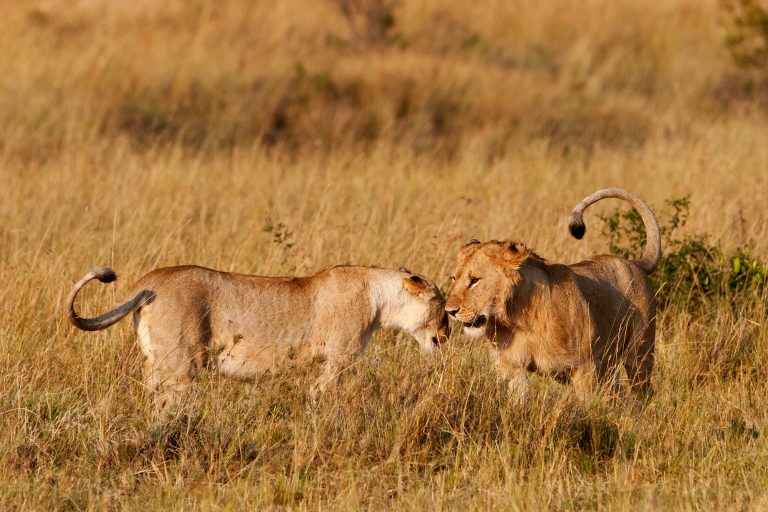
The conservancy is part of the Mara ecosystem, so the wildlife is the same as the rest of the Mara: lions, leopards, cheetahs, elephants, buffalo, giraffes, zebras, hyenas and large herds of plains game. What changes is how you see it. With a vehicle limit at sightings, a speed limit and drivers who can leave the track to follow an animal, you tend to spend more time with each sighting than you would at a busy reserve crossing.
The Serengeti-Mara wildebeest herds usually reach the Mara from about July and stay until about October, depending on the rains. The busiest river-crossing action is generally from late July to September. Kenya’s tourism minister was quoted in 2021 saying herds can arrive from mid-June in wet years, and that in dry years they can be late, so no month is guaranteed.
The headline herd size is also debated. The 2023 aerial count by Tanzania’s wildlife research institute estimated about 1.37 million wildebeest, while a 2025 satellite study in PNAS Nexus counted roughly 0.5 million in August 2023. The two used different methods and were taken in different months, so we say that estimates range from about 0.5 million to 1.4 million.
How much of the migration you see inside Mara North depends on the year, the grass and where the herds spread. The Mara River itself runs through the area, with camps listed on both its east and west banks. For the best-known crossing points and how to plan around them, read our guide to Mara River crossings. If seeing a crossing is your main goal, tell us when you request a quote and we will suggest where to base yourself.
How the conservancy differs from the reserve
| Feature | Mara North Conservancy | Masai Mara National Reserve |
|---|---|---|
| Night drives | Allowed in designated areas, with red filters; back at camp by 10 pm | Not allowed |
| Walking safaris | Offered, led by an armed ranger | Not allowed |
| Off-road driving | Only to view wildlife, under set rules | Not allowed; marked tracks only |
| Who can drive in | Guests of member camps | Any visitor with a permit, including self-drivers |
| Crowding | Few beds per acre; vehicle limit of 5 per sighting | Can be busy at popular sightings in peak months |
| Fees | Conservancy fee, normally part of your camp rate; confirm with the camp | Park entry fee, charged separately |
The reserve has its own strengths, including the main river crossings and a wider network of tracks, which is why many travellers split their stay. Our complete Masai Mara safari guide covers the reserve in more detail.
Game drive rules in Mara North
The conservancy publishes its own etiquette rules, and your guide will brief you at the start. The main points, taken from the Mara North Conservancy’s etiquette page, are:
- No more than 5 vehicles at a sighting. Extra vehicles wait about 100 metres away, and each vehicle has 10 minutes before giving way. The vehicle that found the animal may stay.
- Stay on the track. Vehicles may leave it to view wildlife, and for the Big Five the vehicle takes the shortest route and keeps 20 metres from the animal.
- Speed limit of 40 km/h.
- Do not leave the vehicle near wildlife. You can step out only at picnic and sundowner sites.
- No standing on the roof near animals, and no sitting on the roof at predator sightings.
- Night drives run only in designated areas and end with a return to camp by 10 pm. Cubs may be viewed at night only when they are 4 months or older.
- Vehicles keep away from walking or riding safaris and take another route.
Other conservancies have their own limits. A travel company reports four vehicles per sighting in Naboisho, but that figure is not from the conservancy, so check with your camp.
Where to stay in and around Mara North
The camps below are listed against Mara North Conservancy by Expert Africa or by the Mara Conservancies association. Tiers and exact locations come from directories, not from the camps, and availability changes, so we confirm each camp before we put it in an itinerary. We give no rates here because published figures conflict.
- Kicheche Mara Camp is listed as luxury and is in Mara North.
- Saruni Mara is listed as luxury and sits on the conservancy’s northern edge.
- Offbeat Mara is described as popular with families and return travellers.
- Offbeat Ndoto is described as ideal for couples or small groups.
- Serian – The Original is on the east bank of the Mara River, and Ngare Serian is on the west bank.
- Karen Blixen Camp is listed in the conservancy.
- Basecamp Mara Houses offers exclusive-use villas, described as suited to families or small groups.
- Elephant Pepper Camp is placed in Mara North by Expert Africa, though another directory puts it nearer Enonkishu.
Some family-friendly camps accept children, but age limits vary by camp. Ask us before you book and we will check the current policy for the camp you want.
Two ways to build a Mara trip
- 7 Days Maasai Mara Migration Safari: a week built around the Mara, good if you want time for the reserve and a conservancy stay. From USD 4,900 per person.
- 8 Days Migration Majesty Safari: one extra day for river crossings and slower game drives. From USD 6,530 per person.
Prices are per person on a midrange, low-season, two-sharing basis and depend on season, group size and lodge choice. We can add a Mara North camp to either trip.
Safaris that fit this guide
 5-Day Masai Mara Migration SafariMore time with the herds in the Mara5 days · from $2,750 ppView trip →
 3-Day Masai Mara SafariBig cats and the Mara in a long weekend3 days · from $1,420 ppView trip →
 9-Day Migration Majesty SafariAmboseli, Nakuru and the Mara in migration season9 days · from $6,530 ppView trip →
Every trip is private and can be changed to suit you. Get a free, tailor-made quote in 6 hours →
Best time to visit Mara North Conservancy
| Months | What to expect |
|---|---|
| July to October | Herds usually present in the Mara; river crossings busiest from late July to September; the most visitors |
| November to December | Herds begin to head south with the short rains, usually reaching the south by December; resident wildlife remains |
| January to March | Wildebeest calve in the southern Serengeti in Tanzania, not in the Mara; resident Mara wildlife is the focus |
| April to June | Long rains; herds are in Tanzania, then may arrive from mid-June in wet years |
The resident wildlife is in the Mara all year, so the conservancy is worth visiting outside the migration months. In July to October you pay for the herds, and you should book early. Our 11 Day Migration Fly-in Package is a longer option from USD 7,625 per person if you want to combine the Mara with other parks.
Conservancy fees
Conservancy fees are separate from the reserve’s park entry fee. In most cases they are included in the nightly rate at a camp inside the conservancy, but we could not confirm that on an official page, so ask whether conservancy fees are included. One commercial 2026 guide gives USD 80 to 120 per non-resident adult and USD 45 to 75 per child for private Mara conservancies. Other guides suggest figures up to about USD 150 per person per night, so treat all of these as indicative. No tariff from Mara North itself was available. Fees last verified: October 2026.
How a day that crosses from the conservancy into the reserve is charged was not stated on any page we read, so your camp should confirm it before you travel.
Who Mara North suits
- Travellers who dislike crowds. A cap of 5 vehicles per sighting keeps things calmer than a busy crossing point.
- Return visitors. Walks and night drives add activities you cannot do in the reserve.
- Photographers. Drivers may leave the track to position the vehicle, within the rules above.
- Families. Several camps are described as family-friendly, but check minimum ages.
If you want something smaller and quieter, read about Ol Kinyei Conservancy, or see the smaller Mara conservancies such as Lemek and Enonkishu.
What to pack
Pack neutral layers, because mornings and evenings on open vehicles are cool, even in the dry months. Bring a warm jacket for early starts, a hat, sunscreen, binoculars and a camera with spare batteries. A rain jacket is useful from April to June and in November. If you plan a guided walk, wear closed shoes and long trousers in muted colours, and follow your guide’s briefing.
Get your free safari quote in 6 hours
Tell us your dates and who is travelling. A planner in our Nairobi office replies within 6 hours with a day-by-day itinerary, the camps we suggest and a fully itemised price. No payment is needed to enquire.
Prefer to talk? WhatsApp or call +254 799 871 255.
Frequently asked questions
How big is Mara North Conservancy?
The Mara Conservancies association lists it at 28,487 hectares in its table and 29,170 hectares in its text, which is about 285 to 292 square kilometres, or roughly 70,000 acres. It is the largest of the Mara conservancies.
Can I self-drive in Mara North Conservancy?
No. Self-driving is not permitted in the Mara conservancies. Only guests staying at member camps can game drive there, with the camp’s guide and vehicle.
Are night drives and walking safaris allowed?
Yes. Night drives run in designated areas with red filters and end by 10 pm, and walks are led by an armed ranger. Neither is allowed in the Masai Mara National Reserve.
Can I see the Great Migration in Mara North?
The herds are usually in the Mara from about July to October, and the conservancy is part of that landscape. How many you see in Mara North depends on the year and the grass. For river crossings specifically, many travellers also spend time near the reserve’s river stretches.
How many vehicles can be at a sighting?
No more than 5, according to the conservancy’s etiquette page. Extra vehicles wait about 100 metres away, and each vehicle has 10 minutes before giving way.
Are conservancy fees included in the camp price?
Usually they are part of the nightly rate for guests staying in the conservancy, but we could not confirm this on an official source, so ask the camp. Fees last verified: October 2026.
Is Mara North suitable for children?
Several camps there are described as family-friendly, but age limits vary by camp and we do not quote one. Tell us the ages of your children when you request a quote and we will check each camp’s policy.


Comments are closed